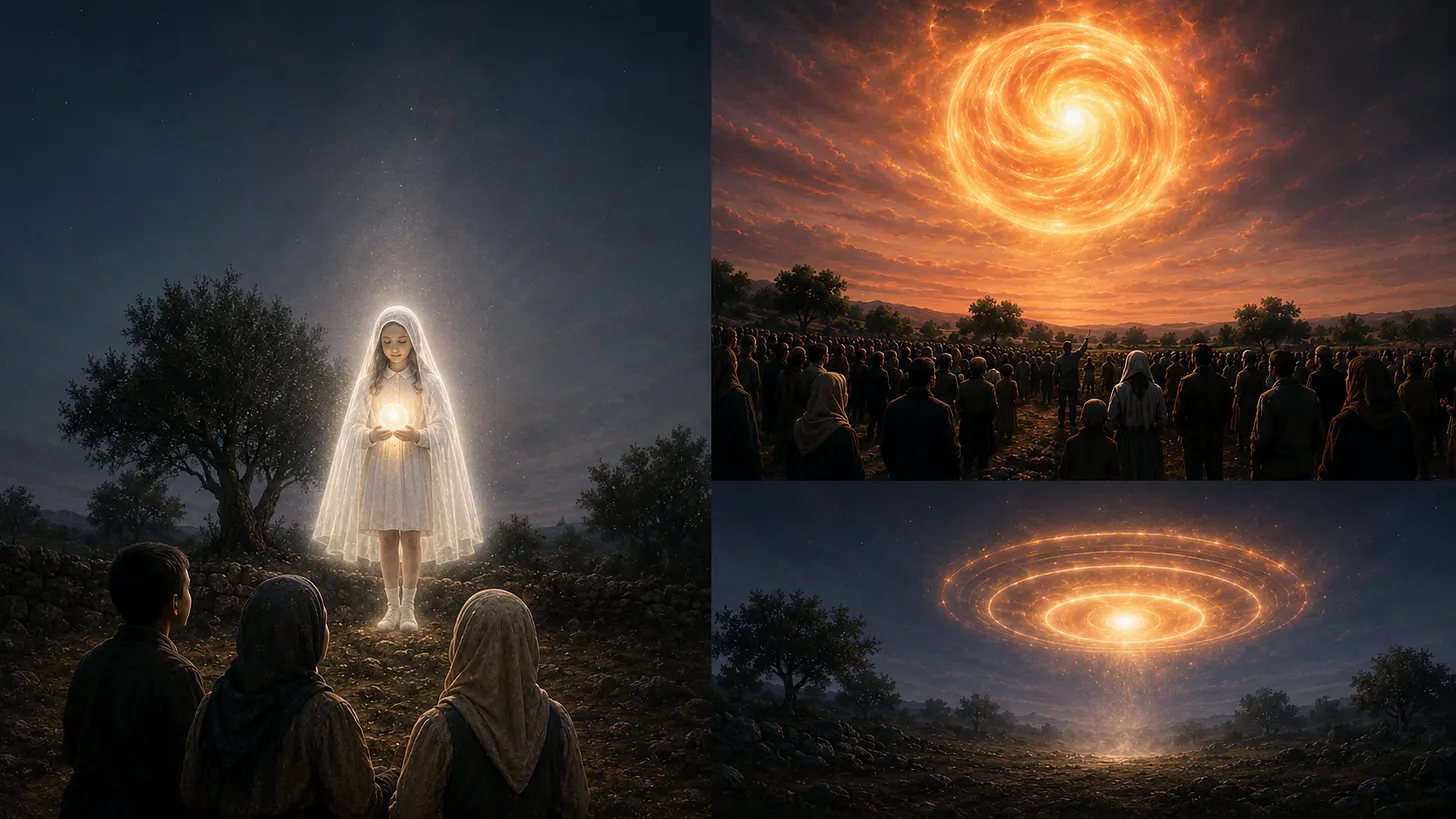
Review of ‘Heavenly Lights: The Apparitions of Fatima and the UFO Phenomenon’
Book Authors: Historians Joaquim Fernandes and Fina d’Armada
The story of Fátima is a popular Catholic mystical narrative centred on three Portuguese children in 1917 – Lúcia dos Santos, aged 10, and Francisco and Jacinta Marto, ages 7 and 6 – who encountered an apparition of the Virgin Mary on six occasions, receiving an urgent message for the world.
The book Heavenly Lights: The Apparitions of Fatima and the UFO Phenomenon, by the Portuguese historians Joaquim Fernandes and Fina d’Armada, reexamines the reported events at Fátima in 1917 through the methods and concepts commonly used in the study of unidentified aerial phenomena. Rather than accepting the traditional Catholic interpretation that the witnesses encountered the Virgin Mary, the authors argue that the earliest testimony describes a strange physical and psychological experience whose religious meaning was established only gradually.
The Precursor Angel Apparition of 1916
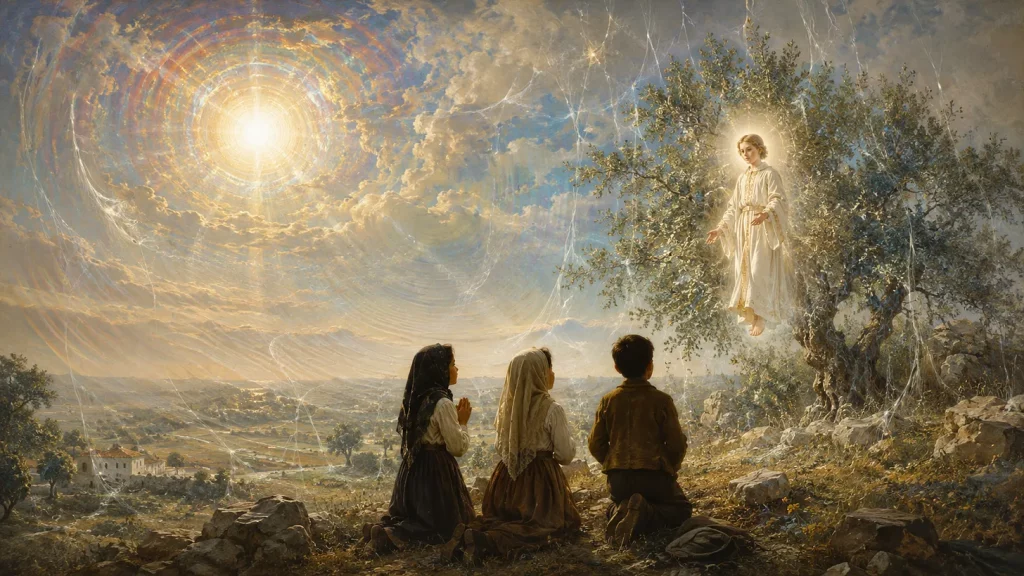
Fernandes and d’Armada present a precursor to the 1917 events in which the three children encountered an angelic being on three separate occasions. The authors suggest this as possibly a crucial conditioning phase designed to prepare the children for the main events of 1917.
Drawing from the earliest records and Sister Lúcia’s raw accounts, the authors describe an entity that looked like a glowing, transparent youth of fourteen or fifteen years old who moved seamlessly through the air rather than walking. During these encounters, the phenomenon exhibited striking physical anomalies, most notably a hovering chalice and disk (representing a Eucharistic host) that remained suspended completely motionless in mid-air while the entity prostrated itself before these elements.
The authors place considerable emphasis on the severe physiological and psychological after-effects experienced by the children, which they argue closely mirror modern close-encounter reports. Following the visitations, the children suffered from a crushing physical exhaustion and a profound internal paralysis that left them unable to speak or move for hours. Furthermore, the communication featured notable sensory discrepancies, as Francisco could see the luminous figure clearly but was entirely unable to hear its voice. Ultimately, the book presents these 1916 events not as spiritual visitations, but as high-strangeness encounters with an anomalous intelligence and possibly altered the children’s consciousness to accustomed them to intense energetic fields.
Early Witness Testimonies
The book is based largely on early witness statements and documents connected with the original investigations of the apparitions. Its central finding is that the first descriptions given by the three shepherd children differ in important respects from the familiar image of Our Lady of Fátima. According to the authors, the figure was initially described as small, luminous and apparently youthful, wearing clothing that did not correspond closely to conventional representations of the Virgin Mary.
They contend that later accounts became more recognisably Marian as the children were questioned by clergy and as the events were interpreted within the language and expectations of Portuguese Catholicism.
Various Phenomena Reported
Fernandes and d’Armada place particular emphasis on the unusual lights, clouds, sounds and atmospheric effects reported around the apparitions. Witnesses described luminous objects moving through the sky, flashes resembling lightning, a humming or buzzing sound and the appearance of a small cloud near the tree where the figure was said to appear.
Microwave Radiation
Fernandes and d’Armada speculate on the possibility that microwave radiation may have contributed to some of the unusual effects reported during the Fátima events. They connect it with the sudden intense heat, the rapid drying of wet clothing and ground, and the humming or buzzing sounds heard near the apparition. The authors also refer to the microwave auditory effect, in which pulsed microwave energy can produce clicks, buzzing or other sounds that seem to originate inside a person’s head. They speculate that this might explain why the children appeared to receive communication from the luminous figure even when its lips were not seen to move.
The authors compare these various phenomena with features found in modern UFO encounter accounts, particularly cases involving glowing objects, altered perception, apparent communication and physical effects upon witnesses.
October 13, 1917: Miracle of The Sun
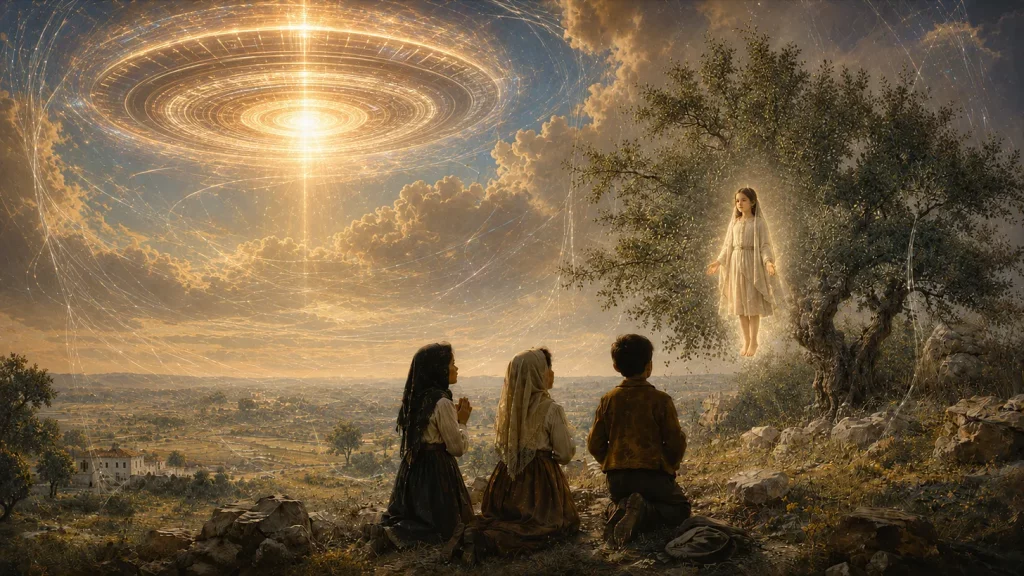
The book also reconsiders the event known as the Miracle of the Sun on 13 October 1917. Thousands of people reported that the Sun appeared to spin, change colour, move erratically or descend towards the Earth. The authors argue that the descriptions may not refer to the astronomical Sun itself, since such movement would have been visible over a vast geographical area and would have produced catastrophic planetary consequences. They suggest instead that witnesses may have observed a luminous object in the direction of the Sun, combined with atmospheric and psychological effects. In their interpretation, the event resembles a large scale sighting of an unidentified aerial phenomenon more than a literal disturbance of the Sun.
The Phenomena Of Angel Hair
Fernandes and d’Armada also connect the Fátima events with the phenomenon known as angel hair. Witnesses reported delicate white material descending from the sky during the apparitions, particularly on 13 September and 13 October 1917. It was described as resembling fine threads, flakes, petals or small white flowers and was said to disappear rapidly when it reached the ground or was touched.
The authors compare these accounts with reports from later UFO encounters in which luminous aerial objects were followed by showers of a fine fibrous substance. This material, commonly called angel hair, has often been described as resembling cobwebs, cotton or silky strands and as dissolving or evaporating soon after falling. Reports of the phenomenon have accompanied notable UFO sightings in several countries.
In Heavenly Lights, the presence of angel hair strengthens the connection between the Fátima apparitions and the wider UFO phenomenon. The falling material is presented as one element within a larger pattern that includes luminous objects, unusual clouds, coloured light, atmospheric effects and changes in physical sensation. The authors suggest that witnesses understood the descending substance as flowers from heaven because this interpretation reflected the religious culture surrounding the apparitions. Within a modern UFO context, the same phenomenon became known as angel hair.
This comparison supports the authors’ broader argument that similar extraordinary events may receive different names and meanings according to the beliefs of the people who experience them. At Fátima, the white material became part of a sacred manifestation, while in later encounters it was associated with unidentified aerial objects. In both settings, angel hair appears as a physical sign accompanying a remarkable event in the sky.
Cultural Influences On The Narrative
A significant theme of the author’s is the influence of culture upon extraordinary experiences. The authors do not simply claim that the children saw non human intelligence in the popular sense. Their broader argument is that unexplained encounters may be interpreted according to the religious and social ideas available to the witnesses. In rural Portugal during the First World War, three Catholic children were more likely to understand an unfamiliar luminous being as an angel or the Virgin Mary rather than a non human intelligence. The religious form of the story may therefore represent a cultural interpretation of an experience whose original nature remains unknown.
Critical Of The Ecclesiastical Narrative
The authors are critical of the way the official narrative developed. Fernandes and d’Armada maintain that questioning by priests, family members, journalists and investigators may have shaped the children’s recollections. They examine differences between early interviews and later memoirs, especially those written by Lúcia many years after the events. From these changes, they conclude that the standard account cannot be treated as a simple, unaltered record of what occurred in 1917. Memory, suggestion, religious instruction and institutional interests may all have contributed to the final story.
Authors Conclusions:
The authors propose that the Fátima events belong to the wider history of anomalous aerial and visionary experiences. They regard the case as neither a Catholic miracle nor unambiguous evidence of non human intelligence or physical craft. Instead, they present it as a complex encounter involving unexplained lights, visionary figures, physical sensations, crowd psychology and later religious interpretation. Their principal conclusion is that the original evidence is more ambiguous and unusual than either the traditional devotional account or a simple sceptical explanation might suggest.
My Own Reflections From Reading Heavenly Lights
Joaquim Fernandes and Fina d’Armada draw upon modern day ufology to skillfully reflect upon the multifaceted dimensions of the Fátima phenomenon. They especially speak into how the UFO/UAP phenomenon interacts with human consciousness drawing parallels between what happened to the Fatima children with modern day accounts of people who have directly encountered non human intelligences. Professor Jacque Vallee has been a pioneering voice in the UFO community connecting the modern day UFO phenomenon with human consciousness. His work has inspired others to make this connection too. The late Dr John Mack through carefully listening to experiences of those who have directly experienced non human intelligences, informed the discipline of Ufology profoundly.
As a psychotherapist whose clinical practice is informed by both phenomenology and the field of trauma studies, the work of Fernandes and d’Armada extended my own inquiry into the realms of both consciousness studies and analytical psychology.
The Fátima phenomenon may touch into the intersection between an external anomalous intelligence and the deeper structures of the human mind. The high strangeness witnessed by the children in 1916 and 1917—manifesting as a simultaneously psychophysical and psychospiritual phenomenon —may have acted as a direct catalyst for altered states of consciousness. From a Jungian perspective, the compassionate luminous Lady might be understood as an archetypal projection of the collective unconscious – borne from that tumultuous period of history – desiring consolation and hope in a world ravaged by the First World War and the impending trauma of the soon to happen Russian Revolution. Similarly, the terrifying descent of the sun might speak into a collective unconscious gripped by a nascent dread of industrialised warfare and the destructive potential of human technology to bring about mass annihilation.
In relation to the issue of human consciousness being affected by encountering anomalous phenomenon, the severe physiological aftereffects of the children’s encounter with the angel in 1916, -both exhaustion and paralysis – are noteworthy. These effects suggests the possibility that the nervous systems of the children were operating under the strain of an expanded energetic field. Potentially in this field they were downloading information that the conscious ego could only interpret through the available cultural archetype: that of an angel.
The children’s later encounter with the Lady in 1917 was very much in contrast to their encounter with the Angel in 1916. The Lady was actually energising and exciting for them. This might have brought with it a different form of conscious (euphoric) overwhelm. This overwhelm might have gradually shifted the children’s perception from seeing an anomalous, beautiful, short skirted entity into a seeing a traditional Virgin Mary archetype. This shift therefore might not have been merely a consequence of religious institutional pressure but might be an example of the mind translating a transpersonal reality into an image it can comprehend.
The Fátima story and the accounts of modern day UAP experiencers could suggest that the human psyche participates actively in anomalous encounters. It might even suggest that the UAP phenomenon is deeply intertwined with the evolution of human consciousness. As the well known wisdom saying suggests with all unknowns, “truth is often the daughter of time”.