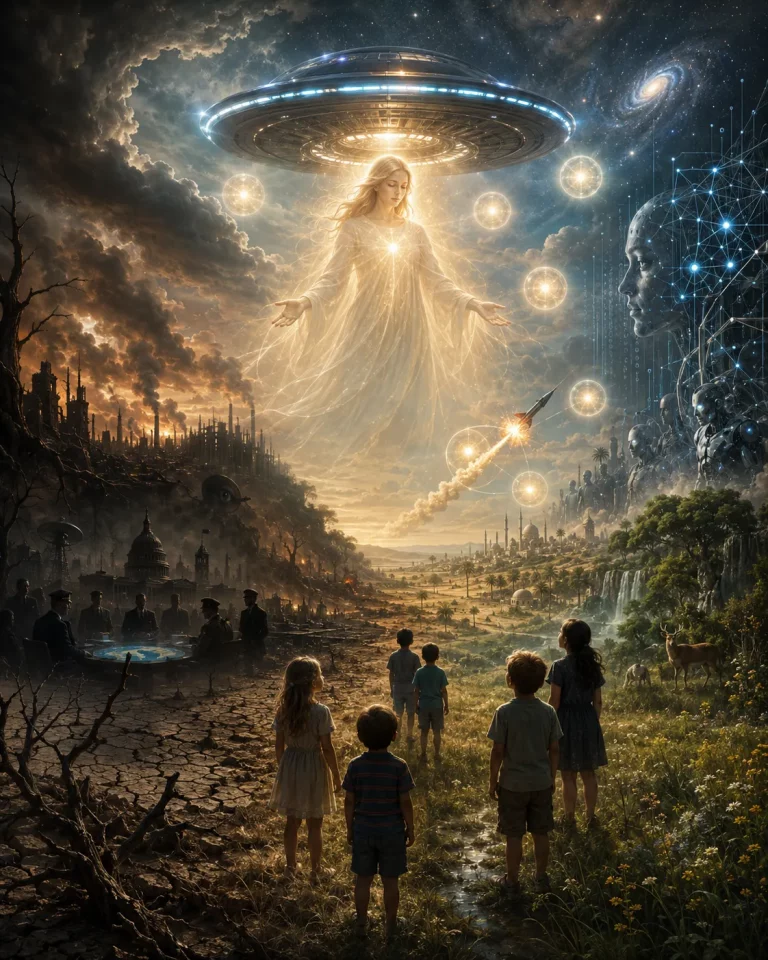
The Lady, the Lights and an Admonition: Apparitions, UFO Encounters and the Possibility of a Transformation in Human Consciousness
Discerning The Phenomenon
I have been slowly working on this article for months. It is ambitious but important. It is a work of discernment which is still discerning. But in this discernment I believe important nuggets of wisdom and meaning are coming forth. These nuggets might speak into the collective journey and experience of humanity, globally, locally, and individually. I hope they do. I hope they will speak to you personally. I am not seeking assent to any specific ideas or beliefs. I have too much respect for you to do this. I am offering this essay as a tool for observation. I invite you to journey with me into very deep waters – drawing upon the wisdom of some profound thinkers to help guide the journey. We can seek jewels that might lay hidden deep on the ocean bed.
Anomalies of the twentieth and twenty first centuries
During the twentieth and twenty first centuries two apparently separate bodies of extraordinary testimony have developed alongside one another. In the religious world, children and adults have reported encounters with the Virgin Mary, Jesus, spiritual beings and other luminous presences who bring messages of prayer, mercy, inner change and warnings about humanity’s future. In the developing UFO literature, witnesses have described mysterious lights, unusual craft, small beings, communication that seems to occur directly through consciousness, altered states of awareness and encounters that sometimes leave them with an equally powerful conviction that humanity is moving in a dangerous direction. These traditions are usually kept apart, yet when they are placed side by side, their similarities become increasingly difficult to ignore.
The main focus of this essay is the curious territory where apparitions and UFO encounters appear to overlap. It will consider the experiences associated with Fátima, Kibeho, Garabandal and Medjugorje, the visions of Saint Faustina, the extraordinary journey described by Betty Andreasson, the Ariel School encounter in Zimbabwe and the continuing experiences of Chris Bledsoe. Although Christian apparitions and modern UFO encounters form the centre of the discussion, they do not exist in isolation. Parallel phenomena appear within Buddhist, Hindu, Islamic and indigenous traditions, where visionary states, encounters with non ordinary intelligences, warnings about human behaviour and experiences of expanded consciousness also appear. These wider traditions matter because they suggest that the pattern under consideration may not be exclusively Christian, Western or conventionally religious.
Once the familiar labels are temporarily set aside, a more complicated picture begins to appear. There are lights that behave strangely, luminous or unusual figures, communication without ordinary speech, altered bodily awareness, changes in the perception of time, symbolic imagery and warnings concerning war, violence, ecological destruction and human division. Most strikingly, the message is often not really about the extraordinary phenomenon itself. The light in the sky becomes secondary. The unusual being becomes secondary. The deeper concern is human behaviour, human consciousness and the direction in which civilisation is moving.
The experiencers
Again and again, the experiencer is directed away from fascination with the extraordinary and back towards the way human beings live. The language may be mercy and a change of heart in one tradition, compassion and awakening in another, restoration of balance with the natural world in another, or an expansion of consciousness within contemporary UFO testimony. Beneath these differences there appears to be a recurring concern that human knowledge and power have developed more quickly than human wisdom. This raises a possibility very much in the spirit of Jacques Vallée. Rather than treating Marian apparitions, religious visions and UFO encounters as completely separate events that merely happen to share similarities, perhaps they can be considered as different manifestations of a deeper phenomenon that adapts its appearance to the culture, expectations and symbolic language of the people encountering it.
The forms of the phenomenon
In one age the phenomenon may appear as a heavenly Lady. In another it may be interpreted as a fairy, an angel, a spirit or a protective being. In a technological culture it may present itself through craft, humanoid figures and apparently scientific procedures. Within another spiritual culture it may appear as a higher intelligence, an ancestral presence or an encounter with a greater field of consciousness. If there is an underlying intelligence or deeper reality behind at least some of these events, perhaps its purpose is not simply to announce its existence. Perhaps it is attempting, slowly and indirectly, to influence the development of human consciousness and, through consciousness, the direction of human destiny.
Three lenses for approaching the material
Three approaches are especially useful for considering this possibility. The first is the work of Jacques Vallée, the French born computer scientist, astronomer and long standing researcher of UFO and anomalous phenomena. Vallée became increasingly dissatisfied with the simple explanation that UFOs are merely spacecraft arriving from distant planets. He was struck by the similarities between modern encounters and much older traditions involving fairies, spirits, religious apparitions and strange visitors. His idea of the phenomenon as a possible control mechanism suggests that anomalous events may do more than reveal unusual beings or objects. They may influence human belief, imagination and behaviour over time. The word control here need not imply domination. It can be understood more like feedback within a living system, in which an event occurs, consciousness responds, culture changes and the effects spread far beyond the original encounter.
The second lens comes from Carl Jung and analytical psychology. Jung was a Swiss psychiatrist and psychologist whose work on the unconscious, archetypes and symbolic imagery became highly influential during the twentieth century. He was particularly interested in recurring symbolic forms that appear across cultures and historical periods. Images such as the mother, the divine child, the circle and the mandala could, in Jung’s view, emerge with particular force during periods of psychological or cultural imbalance. Applied to apparitions and UFO encounters, this approach asks whether the form of an extraordinary experience may be shaped partly by the unconscious and by the symbolic needs of a particular time. Importantly, this does not necessarily mean that the event is imaginary. Jung remained open to the possibility that an external event and an archetypal response might occur together, with something genuinely anomalous taking place while the human psyche gives it a culturally recognisable form.
The third lens is phenomenology, which developed as a philosophical discipline around the beginning of the twentieth century, particularly through the work of Edmund Husserl. Its starting point is simple but powerful. Before deciding what an experience means or what caused it, we should first describe it as carefully as possible. Instead of asking immediately whether a witness saw the Virgin Mary, an extraterrestrial or a psychological projection, phenomenology asks what was actually experienced. Was there light, sound, silence, apparent communication through consciousness, altered bodily awareness, a changed sense of time, a powerful feeling of presence or a lasting transformation afterwards? This approach allows religious visions and UFO encounters to be compared at the level of lived experience without prematurely reducing one to the other.
These three approaches complement one another. Phenomenology helps us describe the event, Jung helps us understand the symbolic forms through which it may appear, and Vallée helps us ask what larger effect the phenomenon may have upon individuals, cultures and perhaps the direction of human consciousness itself.
Fátima and the meeting of private vision with public phenomenon
The apparitions reported at Fátima in Portugal in 1917 provide perhaps the clearest starting point. Three shepherd children, Lúcia dos Santos and her cousins Francisco and Jacinta Marto, described repeated encounters with a radiant female figure whom they came to understand as the Virgin Mary. From a phenomenological point of view, their descriptions are striking because of the importance of light. The figure was not simply a woman standing beneath a tree. She appeared within an intense luminosity and seemed almost to be composed of it. The children described the presence as extraordinarily beautiful, loving and serious.
They did not experience the apparition in precisely the same way. Lúcia could see and hear the figure and spoke with her. Jacinta could see and hear her. Francisco could see the figure but did not hear the words. The same event therefore appeared to produce different degrees of sensory access among witnesses standing together. This is phenomenologically fascinating because it suggests that perception itself may have been part of the encounter. Several later anomalous cases show something similar, with one witness seeing a being, another seeing only a light and another experiencing almost nothing.
Jung’s approach adds another dimension. The radiant mother is one of the most powerful symbols available within the Christian imagination, carrying associations of protection, sorrow, compassion, nurture and intercession. If an external anomaly were interacting with the minds of the children, the Marian form might have been the way in which that experience became psychologically and culturally intelligible. From Vallée’s perspective, the form may be even more significant. The manifestation enters a symbolic world already capable of carrying the message.
The messages themselves concerned prayer, moral renewal, war, Russia and the direction in which humanity was moving. Their purpose was not simply to disclose hidden information. The warning was directed towards a change of heart and a more peaceful way of living. The events of 13 October 1917 add another layer of strangeness. A large crowd gathered after the children had said that a public sign would occur, and many subsequently described the sun as changing colour, spinning, trembling or appearing to move towards the Earth. Whatever happened that day remains debated, but the event is important because a phenomenon previously restricted to selected visionaries apparently became, in some form, collectively perceptible.
Fátima therefore contains two different modes of manifestation. There is the intimate encounter with an apparently intelligent luminous presence, and there is a public aerial display. The first involves relationship and communication, while the second involves spectacle and apparent physicality. Jung might ask how the public event activated powerful archetypal meanings around light, heaven and revelation. Vallée might ask whether the event introduced a symbol into European consciousness at a moment of war and upheaval, producing effects that would continue for generations.
The Portuguese historians Joaquim Fernandes and Fina d’Armada have added another layer to the discussion by returning to early witness descriptions and comparing them with later UFO reports. Their work draws attention to unusual luminosity, atmospheric changes, aerial effects and sensory disturbances that can appear strikingly similar to features found in modern encounter literature. The value of their approach is not necessarily that it proves an extraterrestrial explanation. Rather, it restores some of the original strangeness to the Fátima events and challenges the assumption that later devotional language completely explains what occurred.
Vallée would suggest that the Marian form itself is significant. A luminous intelligence concerned with human destiny appears within a Catholic culture through the most powerful available image of maternal compassion, warning and intercession. The form communicates before a word is spoken.
Kibeho and the vision of catastrophe
The reported apparitions at Kibeho in Rwanda beginning in 1981 have a very different emotional character. Here the experience moves from tenderness into horror. Several young people reported encounters with a female figure identified as the Mother of the Word. During some of the experiences the visionaries entered states of intense absorption, their attention apparently fixed upon something invisible to the people around them. From a phenomenological perspective, this altered state matters because the witnesses seem to move into another field of perception while remaining physically present among observers.
The most disturbing episodes involved visions of extraordinary violence. Witnesses described bodies, rivers of blood, people killing one another and scenes of social destruction. These images later became inseparable from memories of the genocide that devastated Rwanda in 1994. Rather than treating Kibeho simply as a question of whether the future was predicted accurately, Jung and phenomenology allow us to ask whether prophetic imagery can express a truth already present within collective consciousness before it becomes visible historically.
Hatred, fear and division may already be gathering within a society long before catastrophe erupts. A vision may dramatise what the culture is becoming before ordinary consciousness is willing to recognise it. Jung might understand the horrific imagery as the eruption of a collective shadow, representing violent material a society refuses to acknowledge within itself. Vallée’s control mechanism model adds another possibility. The vision becomes a warning signal introduced into the system before the consequences become irreversible. The phenomenon does not prevent catastrophe by force. It reveals the trajectory and leaves human beings free to respond.
Garabandal and the illumination of conscience
The reported apparitions at Garabandal in northern Spain between 1961 and 1965 add another unusual set of phenomena. Four girls reported encounters with the Virgin Mary and Saint Michael, accompanied by altered states of consciousness, unusual movements and apparent changes in bodily responsiveness. Observers described the girls walking backwards over difficult ground without appearing to stumble. During ecstasy they sometimes seemed unusually insensitive to external stimulation, while their heads could remain tilted upwards and their attention fixed upon a presence invisible to everyone around them.
Phenomenologically, the body becomes part of the event. The altered consciousness does not remain confined to interior imagery but appears to affect posture, movement, pain response and attention. The most intriguing aspect for the present argument is the sequence described as the Warning, the Miracle and the Chastisement. The Warning is said to involve a worldwide illumination of conscience in which every human being becomes aware of his or her moral condition. It is an extraordinary concept because the event is both universal and completely personal. Everyone experiences it, yet each person experiences the truth of his or her own life.
If taken at face value, the Warning would amount to a global alteration of consciousness. Jung might describe it as a vast confrontation with the shadow, in which the ordinary defences through which the personality hides from its contradictions temporarily fail. Phenomenology directs attention to what such an event would mean experientially. It would not primarily be a spectacle in the sky but an inward encounter that somehow became universal.
Vallée’s framework makes the idea still more provocative. If a phenomenon wished to redirect civilisation without removing human freedom, an illumination of conscience would be a remarkably subtle intervention. It would not command humanity but change what human beings are capable of seeing about themselves. The Miracle would then introduce public confirmation, while the Chastisement would concern consequence. The sequence becomes consciousness, confirmation and choice.
Many UFO experiencers describe something much less dramatic but structurally similar. After an encounter they may feel differently about the Earth, violence, mortality or other human beings. They report an unexpected awareness of interconnection and of humanity’s dangerous immaturity. The encounter becomes moral confrontation.
Saint Faustina and mercy before judgement
The experiences recorded by Maria Faustina Kowalska during the 1930s belong explicitly to Christian mystical tradition, yet they add another important element to this pattern. Faustina described repeated encounters with Jesus, and the centre of the message is Divine Mercy. Phenomenologically, her accounts involve direct presence, inward communication, altered awareness and the powerful use of light. The experience is relational rather than abstract.
The Divine Mercy image emerges from her description of Christ with rays flowing from his heart. Light therefore becomes more than visual brightness. It carries meaning. Jung might regard the image of Christ radiating mercy as an archetypal expression of reconciliation between judgement and compassion. The individual is confronted with moral truth but not abandoned to despair.
There is an important social context connected to Faustina’s mystical experience of mercy: World War 2 and the Holocaust. Her visions occurred between 1931 and 1938. Her convent was geographically close to where the Nazi concentration camps would be situated. Auschwitz was 37 miles away and Płaszów only 1.5 miles away. Faustina died on the 5th October 1938. Nazi Germany invaded Poland eleven months later in September 1939. The Holocaust was one of histories most brutal genocides. Science and technology were used mercilessly to subjugate, torture and murder Jews, gypsies, gay men, Slavs, the disabled, communists, Jehovah Witnesses, political, religious and moral dissenters and others.
What is particularly important for the wider argument is the structure. Mercy comes before judgement. Warning is therefore not primarily an announcement of dire consequence but the creation of a space in which transformation remains possible. From Vallée’s perspective, this resembles another form of corrective feedback. The message does not abolish human choice. It makes another trajectory available.
There is a famous prayer from Faustina’s diary that has a universal quality to it. The prayer uses Christian terminology to speak to the consciousness of Christian believers. But the content has an archetypal resonance that would likely affect anyone who reads it. The prayer conveys something of the phenomenology of Faustina’s experience:
Help me, O Lord, that my eyes may be merciful, so that I may never suspect or judge from appearances, but look for what is beautiful in my neighbour’s souls and come to their rescue.
Help me, that my ears may be merciful, so that I may give heed to my neighbours’ needs and not be indifferent to their pains and moanings.
Help me, O Lord, that my tongue may be merciful, so that I should never speak negatively of my neighbour, but have a word of comfort and forgiveness for all.
Help me, O Lord, that my hands may be merciful and filled with good deeds, so that I may do only good to my neighbours and take upon myself the more difficult and toilsome tasks.
Help me, that my feet may be merciful, so that I may hurry to assist my neighbour overcoming my own fatigue and weariness. My true rest is in the service of my neighbour.
Help me, O Lord, that my heart may be merciful so that I myself may feel all the sufferings of my neighbour. I will refuse my heart to no one. I will be sincere even with those who, I know, will abuse my kindness. And I will lock myself up in the most merciful Heart of Jesus. I will bear my own suffering in silence. May Your mercy, O Lord, rest upon me.
Amen.
Medjugorje and the gradual shaping of consciousness
The reported apparitions at Medjugorje began in 1981 and differ from Fátima and Kibeho principally because of their extraordinary duration. Rather than consisting of a short sequence of dramatic manifestations, the Medjugorje phenomenon developed into a continuing relationship between the visionaries, the reported presence and an international community.
From a phenomenological perspective, several features deserve attention. The figure appears youthful, beautiful and luminous. Communication occurs with selected witnesses while those around them do not perceive the presence directly. The visionaries appear absorbed within a shared field of attention, and their responses sometimes appear synchronised despite the absence of an obvious external stimulus. The messages themselves are often remarkably simple. Prayer, peace, fasting, forgiveness, Scripture, inner change, love and reconciliation recur again and again.
At first this repetition may seem almost disappointing to anyone hoping for spectacular revelation. Yet Vallée’s model changes the way repetition can be understood. A control mechanism does not necessarily operate through a single overwhelming event. It can work through constant small adjustments. Medjugorje may therefore be considered as a long process of feedback directed towards human behaviour, with the recurring invitation to move away from hatred and judgement and towards prayer, forgiveness, peace and renewed attention to what is essential.
Jung’s approach also helps here. Repetition deepens symbolic patterns. The maternal figure appears again and again, carrying associations of nurture, correction, sorrow and protection. The archetype is not merely encountered once but woven into the lives of the visionaries and the community surrounding them. Phenomenology reminds us that this is not simply a collection of messages. For the visionaries, it is described as a continuing relationship with an experienced presence.
Medjugorje: some parallels with UFO abduction
Another striking element within the Medjugorje accounts is the testimony of Vicka Ivanković and Jakov Čolo that the Virgin Mary did not merely show them visions of Heaven, Purgatory and Hell, but physically took them there. In Vicka’s account, Mary took her by one hand and Jakov by the other. Jakov became frightened because he thought this meant they would not return. He reportedly protested that Mary should take Vicka instead because she had several brothers and sisters, whereas he was his parents’ only child. Vicka later explained that his reluctance came from his fear that they were being taken away permanently.
Vicka and Jacov seemed to physically rise from the room and pass beyond their ordinary surroundings into radically different realms of experience. Other visionaries described being shown these realities more like a vision, but Vicka and Jakov insisted that their own experience involved being taken bodily. Phenomenologically, this creates an intriguing parallel with UFO abduction and contact narratives, in which witnesses describe being removed from familiar surroundings, transported by non ordinary means, taken through unfamiliar environments and eventually returned with their understanding of reality profoundly altered. The comparison becomes especially interesting when placed beside Betty Andreasson, whose apparent journey aboard a craft gradually develops into passage through symbolic realms and towards the Great Door and the One. In both cases, the journey becomes more than movement through physical space. It functions as an initiation into a larger reality. Jung might recognise here the ancient archetype of the otherworld journey, found in myths of descent, ascent and passage through realms beyond ordinary life, while Vallée might ask whether the modern abduction narrative and the older religious journey are culturally different expressions of the same underlying encounter pattern. The outward vehicle changes, but the deeper structure remains remarkably similar: the experiencer is taken out of the ordinary world, crosses a threshold, encounters realities normally hidden from human perception, receives knowledge intended to change how life is understood and then returns to ordinary existence as a witness to what has been experienced.
Mirjana Dragićević Soldo: apostles of love
Within the Medjugorje material, the messages associated with Mirjana Dragićević Soldo possess a distinctive quality. Her reported mission became particularly associated with those described not simply as unbelievers but as people who have not yet experienced the love of God. That phrase changes the relationship between believer and outsider. The person beyond faith is not primarily an enemy to be defeated or a problem to be corrected. They are someone who has not yet experienced boundless, divine love. The depth of inclusivity and compassion here is profound.
Responsibility therefore turns back upon the believer. If you claim to know divine love, what has that knowledge made you become? The expression particularly associated with Mirjana, apostles of love, captures this movement. Her messages frequently feel more intimate and maternal than the more general Medjugorje messages. There is sorrow for people who remain distant from God, a repeated warning against judgement and a strong emphasis upon allowing one’s life rather than argument alone to communicate faith.
Jung might interpret this maternal voice as a corrective to a religious consciousness that can easily become rigid, judgemental or divided into insiders and outsiders. Vallée’s model makes the repeated simplicity of these messages more interesting still. The phenomenon does not appear to be trying to fill the human mind with extraordinary information. It appears to be trying to form habits of consciousness. The questions become whether one can forgive, refrain from judgement, look upon another person without reducing them to a category and allow one’s life to become an expression of compassion.
Betty Andreasson and the UFO as initiation
Betty Andreasson takes us into what initially appears to be completely different territory. Her central reported encounter began on 25 January 1967 at her family home in South Ashburnham, Massachusetts. What starts in recognisable UFO imagery gradually becomes something much closer to a mystical initiation.
Andreasson described a reddish light outside the house followed by the arrival of several small humanoid beings. Her family appeared to enter an immobilised condition while Betty remained conscious and able to interact with the visitors. Communication occurred largely through what she understood as telepathy. One being, identified in the accounts as Quazgaa, seemed to act as a guide. Betty was taken aboard what appeared to be a craft and underwent bodily examinations involving instruments applied to different areas of her body.
Phenomenology is especially useful here because it encourages us to suspend the immediate question of whether the beings were physical extraterrestrials and instead ask what kind of experience is being described. There is altered bodily control, apparent communication without speech, movement between environments, unusual sensory experience and a gradual transition from physical examination towards symbolic instruction.
The technological imagery slowly gives way to spiritual imagery. The beings cease to appear merely as extraterrestrial scientists and become guides. The journey no longer seems primarily to concern movement through physical space. It becomes movement through states or levels of consciousness. Jung would immediately recognise the initiatory structure. The witness is removed from ordinary reality, subjected to trials, confronted by powerful symbols and eventually brought towards an encounter with a deeper order of being. Vallée would notice something equally important. The phenomenon refuses to remain within the category initially used to explain it. The spacecraft becomes a doorway, the alien becomes a messenger and the physical encounter becomes spiritual instruction.
One of the most striking episodes in the Andreasson material concerns an enormous bird like creature surrounded by fire. Betty witnesses what appears to be its destruction and renewal, an image that naturally evokes the phoenix. From a Jungian perspective, the symbolism is rich. Death and rebirth are among the deepest patterns of psychological transformation, with the old form dying before something new can emerge. Fire destroys but also purifies.
Phenomenology reminds us that Betty is not simply told an idea. She experiences an image, and that distinction matters because symbols may alter consciousness in ways that abstract explanations do not. The burning and renewed bird can therefore operate at several levels. It may represent Betty’s personal transformation as her former worldview collapses and reforms, but it may also symbolise humanity itself.
Modern civilisation appears repeatedly within anomalous encounter literature as technologically sophisticated but spiritually immature. We possess powers previous generations could scarcely imagine, yet our moral development has not necessarily kept pace. The phoenix might therefore represent a civilisation reaching a threshold. Humanity may continue towards destruction, or crisis may become the beginning of transformation. Vallée’s model gives the symbol a possible cultural function. An extraordinary image is placed into the consciousness of a witness, the witness tells the story, and the symbol enters collective imagination.
The Andreasson material becomes still more extraordinary with the appearance of the Great Door. Betty described an immense threshold associated with layers of light and passage into what she understood as another order of reality. Phenomenologically, the experience resembles a shift in the mode of consciousness itself. Ordinary spatial language begins to fail. Jung would recognise the threshold as another archetypal image, marking movement between states of being, between the known and unknown and between the ordinary personality and a deeper reality.
Beyond Betty’s Great Door lies what she called the One. The One is not presented as merely another advanced being. It appears closer to ultimate reality itself. The experience is associated with overwhelming light, joy, love and an inability to communicate fully what has been encountered. Here the UFO narrative has effectively become mystical. Betty’s hierarchy moves from humanity to intermediary beings, from intermediary beings to higher intelligences, from those intelligences to a threshold and finally towards the One.
The beings are no longer the destination. They are mediators. From a Valléean perspective, this may be one of the strongest indications that the technological imagery is not necessarily the final meaning of the event. Betty begins with apparent extraterrestrials and ends with unity, light and love. The movement itself may be the message.
There is an important difficulty in studying Andreasson because much of the detailed narrative emerged through hypnotic regression. Memory recovered under hypnosis must be treated carefully because genuine recollection can become mixed with suggestion, expectation and imaginative elaboration. Phenomenology does not remove this problem. It simply allows us to distinguish between the reported structure of the experience and claims about its objective cause. Jung’s approach remains useful even if some of the imagery was partly shaped during regression, while Vallée’s model reminds us that even an ambiguous encounter can become culturally influential.
Ariel School and a warning to the children
The Ariel School encounter of 16 September 1994 in Ruwa, Zimbabwe, adds an especially important dimension because it was not centred upon a single adult experiencer but involved a sizeable group of children. During their school break, around sixty pupils said that they had seen unusual aerial objects and strange beings in the scrubland beyond the playground. The children were later interviewed by researcher Cynthia Hind and by Harvard psychiatrist John Mack, among others. Although individual details varied, a striking degree of consistency appeared in the central features of their accounts. Many described unusual objects, small dark figures with large eyes and a powerful sense that the beings were communicating something directly to them without ordinary speech.
From a phenomenological point of view, Ariel is particularly interesting because the experience appears to have involved both an external visual event and an inward form of communication. Some children described their attention as being drawn especially towards the beings’ eyes, while others spoke of thoughts, images or meanings entering their minds. The content was not primarily technical information about where the visitors came from or how their craft functioned. Instead, several witnesses came away with an impression that humanity was damaging the Earth and that uncontrolled technological development could have dangerous consequences.
This places Ariel within the same broad family of experiences considered elsewhere in this essay, where extraordinary encounters move rapidly from spectacle towards moral concern. A Jungian reading adds another layer. The children were growing up within a late twentieth century culture already familiar with space travel, extraterrestrials and the possibility of advanced technological visitors. The beings they described therefore appeared in a form that made sense within the symbolic world available to them. Yet the message attributed to the encounter was almost a reversal of technological optimism. Humanity imagines the visitor from the stars as more advanced because it possesses greater technology, but the intelligence encountered at Ariel appears instead to question whether technological development without wisdom deserves to be called advancement at all.
The large eyes of the beings are also symbolically suggestive. The children are not merely looking at something strange. They experience themselves as being looked at by something other. This reverses the ordinary human position. Humanity is no longer the observer studying the world. Humanity becomes the object of observation. In Jungian terms, such an encounter might confront the human ego with something outside its normal field of control. The ecological content deepens this reversal because human civilisation itself becomes the object of scrutiny.
Vallée’s control mechanism model makes Ariel even more significant. The encounter was brief and left no universally accepted physical evidence capable of compelling belief, yet its cultural effects have continued for decades. The children told their stories, drew what they had seen and were interviewed on camera. Their testimony entered the wider UFO literature and continues to shape discussion about consciousness, ecology and non human intelligence.
If anomalous phenomena function partly by introducing disruptive symbols and ideas into culture, Ariel provides an intriguing example. The event appears, creates a powerful impression in a group of young witnesses, withdraws into ambiguity and then continues influencing people who were never present at the school. The physical event may have lasted only minutes, while the cultural effect continues more than three decades later.
The fact that the witnesses were children also links Ariel with Fátima, Garabandal, Kibeho and Medjugorje. One possible explanation is that children are more impressionable and therefore more vulnerable to suggestion, and that possibility must remain part of any careful analysis. Yet another possibility is that children have not yet developed the same rigid assumptions about what reality is permitted to contain. An adult confronted with an impossible event may immediately force it into a familiar explanation, whereas a child may be more willing simply to describe what appears before them.
There is also something symbolically powerful about an ecological warning being given to children because they are the generation who will inherit the consequences of decisions made by adults. Humanity’s technological civilisation is constructed largely by one generation, while the warning about its possible consequences is received by the next. Ariel therefore strengthens the wider argument. The form of the encounter belongs unmistakably to the modern UFO imagination, yet the message attributed to it resembles themes found in religious apparition traditions and in wider spiritual teachings. Humanity is portrayed as technologically capable but insufficiently wise, increasingly separated from the natural world and in danger of harming the conditions that sustain life.
Chris Bledsoe and the Lady
Chris Bledsoe provides perhaps the clearest contemporary bridge between religious and UFO traditions. His reported experiences began in North Carolina in 2007 and initially contained familiar UFO elements, including unexplained lights, luminous orbs and encounters with unusual beings. Over time, however, the phenomenon became increasingly spiritual. Prayer became important, healing became important and consciousness became important.
Most strikingly, Bledsoe described an encounter with a luminous female presence whom he calls the Lady. Phenomenologically, the Lady resembles an apparition as much as a conventional UFO entity. She is luminous, relational and associated with meaning rather than merely observation. Jung’s framework makes the feminine form significant because the archetype of the luminous mother or sacred feminine may be emerging within a modern technological setting where such imagery is no longer culturally expected.
Vallée’s perspective makes Bledsoe even more interesting because his experience seems to cross symbolic boundaries. Andreasson begins with beings and moves towards the One. Ariel begins with apparent craft and beings but produces warnings about humanity’s treatment of the Earth. Mirjana begins with the Virgin Mary and remains within a Christian language of love and inner change. Bledsoe begins in the UFO world and moves towards the Lady.
The boundaries begin to dissolve. Perhaps this is exactly what one might expect if the phenomenon is responsive to cultural change.
The feminine presence and the possibility of compensation
The recurrence of a luminous feminine presence deserves particular attention. Mary appears at Fátima, Kibeho, Garabandal and Medjugorje. Bledsoe encounters the Lady. The presence is repeatedly associated with light, compassion, warning, sorrow and concern for humanity.
Jung offers a particularly suggestive interpretation. Modern civilisation has become extraordinarily skilled at control, abstraction, competition and technological manipulation. We can split atoms, alter genes and construct artificial intelligence, yet technological capability has not made us correspondingly compassionate. The return of the feminine image might therefore represent a compensatory movement within human consciousness.
Where civilisation values power, the Mother speaks of mercy. Where it values information, she speaks of wisdom. Where it encourages separation, she speaks of relationship. Where humanity behaves as master of the Earth, she speaks of responsibility. Ariel adds another dimension to this pattern. The children are warned about precisely the technological and ecological imbalance that the feminine symbol appears to correct elsewhere.
At Ariel the warning arrives through strange beings. At Medjugorje it arrives through a Mother. At Bledsoe it appears to move from one symbolic world towards the other. This does not require the Lady to be merely psychological. Jung’s deeper insight is that archetypal symbolism and external reality may interact, with the psyche perhaps providing the form through which something genuinely other becomes perceptible.
Jung and the modern myth in the sky
Jung’s work on flying saucers remains important because he resisted the easy division between physical reality and psychological fantasy. He recognised that the UFO phenomenon could possess enormous psychological significance regardless of the final explanation of individual sightings, while remaining open to the possibility that some events had a physical dimension.
Jung was particularly interested in the circular form of the flying saucer. The circle resembles the mandala, an ancient symbol of unity and psychological wholeness. He asked why such an image should become culturally powerful during the anxious decades following the Second World War, when humanity was living beneath the possibility of nuclear destruction, political division had become global and traditional sources of meaning had weakened.
The appearance of mysterious circles in the heavens could therefore be understood as an image of a wholeness humanity desperately needed. Ariel School complicates this further because the encounter does not merely involve objects in the sky. The apparent intelligence behind the objects seems, according to some of the children, to communicate a judgement upon technological civilisation itself. The modern myth begins commenting upon modernity.
Human beings project their hopes into technological visitors from the stars, yet the visitors, within the encounter narrative, appear to turn around and question technological progress. This is almost perfectly Jungian. The symbol compensates for the one sided consciousness that produced it.
Vallée and the changing masks of the phenomenon
Vallée takes this idea further by comparing modern UFO encounters with older traditions involving fairies, spirits, religious beings and other strange visitors. The outward forms change while the patterns remain surprisingly stable. A presence appears, ordinary reality seems suspended, communication occurs, the witness may enter an altered state and the encounter produces wonder, fear or transformation. The visitor then disappears, leaving behind an experience that may reshape the witness for the rest of his or her life.
Phenomenology reveals the structural similarities. Jung helps explain why the cultural imagery may differ. Vallée asks whether the pattern itself might indicate a continuing phenomenon interacting with human consciousness across history. In one period the encounter is described as fairyland, in another it is angelic, in another it is Marian, and in the technological age it becomes extraterrestrial.
Ariel School is especially interesting because it presents the modern technological mask in an unusually clear form. Children see objects and beings that fit the broad cultural category of extraterrestrial visitation, yet the message attributed to the encounter points away from technological triumph and towards ecological and moral restraint. The mask belongs to technology while the warning challenges technology.
Perhaps these are culturally adapted expressions of the same deeper process.
Similar patterns beyond Christianity
The possible pattern becomes even more interesting when we move beyond Christianity. If Vallée is right that a deeper phenomenon can adopt the symbolic vocabulary of different cultures, then we should not expect the same intelligence to appear everywhere as the Virgin Mary or Jesus. We should expect it to manifest through the religious and cultural forms already available to the people involved.
Tibetan Buddhism offers an interesting example through the tradition of the Nechung Oracle, in which a human medium enters an altered state and is believed to communicate with a protective intelligence. Phenomenologically, this differs from a Marian apparition, yet some important features are familiar. Consciousness changes, another intelligence is believed to become present, communication occurs and guidance is offered to a wider community.
Jung might understand the cultural form through symbolic structures already embedded within Tibetan religious consciousness. Vallée might point out that the phenomenon has no need to present itself as a spacecraft within a culture that already possesses an accepted language for non human intelligence. The underlying corrective principle is familiar. Human suffering is linked to ignorance, attachment and separation, while transformation requires compassion, awareness and wisdom.
The Hindu spiritual world provides another striking parallel through the work of Sri Aurobindo and Mirra Alfassa, known as the Mother. Their central idea was that humanity is not the final stage of evolution and that human consciousness is transitional. Sri Aurobindo understood evolution as involving consciousness itself, while the Mother described experiences in which a higher consciousness appeared to be pressing towards manifestation within earthly life.
She also warned of the danger of human beings acquiring greater powers without developing greater unity and wisdom. This is remarkably close to the central problem emerging throughout this essay. Humanity may possess greater technological capability than the consciousness required to use it well.
From a Jungian perspective, the idea of evolutionary consciousness can be read symbolically as humanity imagining a form beyond its present divided state. From a phenomenological perspective, the Mother understood this not simply as philosophy but as something experienced inwardly. From a Valléean perspective, the language of emerging higher consciousness becomes part of the same larger question concerning whether anomalous and visionary experiences may be participating in a gradual change in how human beings understand their place within reality.
Islamic traditions provide another useful comparison. The religious world of Islam contains angels, meaningful dreams, visionary experiences and the jinn, a category of non human intelligent beings whose existence is understood as part of creation. Jinn are particularly interesting because they occupy a conceptual space surprisingly close to some of Vallée’s ideas. They are neither human nor divine, possess agency and may be helpful, indifferent or deceptive. They exist alongside ordinary human reality without normally being perceived.
Sufi traditions add an important emphasis upon discernment. Extraordinary experiences are not automatically treated as proof of spiritual authority. The question is not merely whether something extraordinary has happened but what kind of consciousness the experience produces. This concern with discernment places Islamic mystical traditions surprisingly close to both Christian spiritual caution and Vallée’s suspicion that anomalous intelligences should not automatically be assumed benevolent simply because they appear powerful.
Indigenous spiritual traditions provide another important family of comparisons, although they need to be approached carefully and within their own cultural contexts. Many understand human beings as participants within a wider community of life that includes ancestors, animals, places and spiritual intelligences. Visionary experiences may involve communication with landscape, animals, ancestors or powers associated with particular places.
The ethical emphasis is often upon balance. Human beings are not masters standing outside nature but participants within a network of relationships. This closely parallels the ecological transformation described by some modern UFO experiencers, and nowhere is that comparison more striking than at Ariel School. The Ariel children inhabit a modern educational environment and describe beings through the vocabulary of UFO culture, yet the message attributed to the encounter is one that an indigenous tradition might express through an entirely different symbolic form. Humanity is damaging its relationship with the Earth.
Several Japanese new religious movements also developed around visions, spirit communication, prophecy and the expectation of profound transformation. Ōmoto is particularly interesting because its revelations included the idea that the world had become disordered and required purification before a renewed spiritual civilisation could emerge. Jung might interpret the language of purification as the symbolic death of an exhausted collective order, while Vallée’s model notices the familiar pattern of disorder, warning, crisis and possible renewal.
Once these wider traditions are included, the possible Valléean pattern becomes much more interesting. If there is an underlying phenomenon attempting to influence human consciousness, there is no reason to expect it to communicate through the same theology everywhere. A Catholic culture can be reached through Mary, Christ, mercy and moral renewal. A Buddhist culture can be reached through compassion, awakening and release from ignorance. A Hindu evolutionary spirituality can understand the process as the emergence of a higher consciousness beyond the limitations of ego. An Islamic culture already possesses categories for non human intelligence and spiritual discernment. An indigenous tradition may understand the message as the restoration of balance between humanity, nature and the wider community of life. A technological Western culture may understand the same corrective pressure through UFOs, non human intelligence and the possibility that consciousness extends beyond the brain.
The theological vocabulary changes, but the direction of the message often does not. Human beings must become less violent, move beyond ego and domination, recognise interconnection, develop compassion, live more responsibly within the natural world and stop mistaking technological power for wisdom.
The interface hypothesis
The idea of an interface may help explain why the phenomenon often appears both familiar and strange. When we use a computer, we do not communicate directly with electrical processes. We encounter symbols that make a deeper system intelligible. If an intelligence existed at a level radically different from ordinary human consciousness, perhaps direct communication would be equally difficult.
It might therefore appear through forms that human beings can understand. The Virgin Mary could function as one such form. The extraterrestrial visitor could function as another. A Buddhist protector, a Hindu manifestation of higher consciousness, an Islamic spiritual intelligence or an indigenous ancestral presence might represent other culturally meaningful forms.
The Ariel beings could represent an especially modern interface, communicating through the imagery of technological otherness while delivering a message that questions the values of technological civilisation itself. Jung explains how such an interface may draw upon archetypal symbolism, while Vallée allows us to ask whether the interface itself is adaptive, changing according to the culture it is attempting to influence.
The form would not necessarily reveal the final nature of the intelligence. It may reveal only the form through which contact becomes possible.
The common message
When the surface imagery is temporarily set aside, a common moral pattern becomes increasingly difficult to ignore. Fátima warns about war and calls for a change of heart. Kibeho reveals the consequences of hatred. Garabandal speaks of conscience, confirmation and consequence. Faustina speaks of mercy before judgement. Mirjana repeatedly calls people away from judgement and towards forgiveness and love. Andreasson is shown a universe in which technological knowledge without spiritual maturity is dangerous. The children at Ariel School report an encounter carrying concern for the Earth and the consequences of technological imbalance. Bledsoe interprets his experiences through healing, consciousness and human transformation.
Buddhist traditions stress compassion and liberation from ignorance. Sri Aurobindo and the Mother speak of humanity developing towards a greater consciousness. Indigenous traditions repeatedly emphasise balance and relationship with the living world. Sufi traditions emphasise discernment and transformation of the self. Modern UFO experiencers frequently speak about nuclear weapons, environmental destruction, human division and the need for a change in consciousness.
Jung might understand these recurring themes as expressions of a collective psyche attempting to compensate for a civilisation that has become dangerously unbalanced. Phenomenology reminds us that many witnesses do not experience these ideas merely as theories. They emerge from encounters perceived as overwhelmingly real. Vallée raises the most provocative possibility of all. What if these repeated messages are not simply parallel products of human imagination but part of a continuing feedback process through which some deeper intelligence attempts to influence the direction of human consciousness?
The message appears remarkably consistent. Humanity possesses more power than wisdom. Our technological development has outrun our moral development. Our crisis is therefore not primarily one of information. It is a crisis of consciousness.
Why would the phenomenon remain ambiguous?
This leads to one of the most difficult questions. If some higher intelligence genuinely wishes humanity to change, why communicate in such uncertain ways? Why children in fields, children on school playgrounds, lights in the sky, disputed apparitions, small groups of witnesses and symbols rather than clear explanations? Why experiences that can be dismissed almost as easily as they can be believed?
Perhaps ambiguity itself is part of the mechanism. Ariel School illustrates this particularly well. The children reported something many of them apparently found vivid and real, yet the event left no artefact capable of forcing the wider world to accept their interpretation. Phenomenologically, anomalous experiences often have precisely this quality of being overwhelmingly convincing to the witness while remaining uncertain to everyone else.
Jung might see this tension as psychologically significant. Symbols transform consciousness partly because they cannot be reduced to one literal meaning. Vallée’s model goes further. Absolute certainty might produce obedience, but obedience is not the same as transformation. Ambiguity preserves freedom. The witness receives enough to be changed but not enough to compel the entire world. The story enters culture as an invitation rather than an order.
Warning rather than rescue
The various traditions considered here repeatedly show a preference for warning rather than rescue. Fátima does not physically prevent war. It warns. Kibeho does not prevent genocide. It reveals where hatred may lead. Garabandal does not remove human freedom. The Warning concerns conscience. Faustina does not describe God forcing humanity into mercy. Mercy is offered. Mirjana does not receive political instructions for governing the world. She is asked to love.
Andreasson is not given advanced technology capable of solving civilisation’s problems. She is given an initiation. The Ariel children are not given a new technology capable of repairing the planet. They receive, according to some of their accounts, the impression that humanity must recognise what its existing technology and behaviour are doing to the Earth. Bledsoe is not handed a machine. He is given an experience.
The Buddhist path does not remove suffering by external force but asks consciousness to awaken. Sri Aurobindo does not imagine transformation coming simply through greater power. Consciousness itself must develop. Indigenous traditions do not offer domination over nature as the solution. They call for restored relationship.
The phenomenon, if there is indeed a common phenomenon beneath these manifestations, seems curiously reluctant to solve humanity’s problems for us. Instead it attempts to change the consciousness that creates those problems.
Steering consciousness rather than controlling history
This is where Vallée’s model becomes especially powerful. Perhaps the phenomenon influences history by influencing consciousness. A direct intervention into politics would be crude, while a change in consciousness could work through generations.
A visionary receives an experience. A symbol emerges. A community forms. The story spreads. People begin to think differently about reality. Some change their behaviour. Some question materialism. Some become more open to the possibility that consciousness is fundamental. Some become more concerned with peace, the Earth or human unity.
Ariel provides an unusually clear example. Children have an extraordinary experience during a school break. They tell adults. Researchers interview them. Their drawings and testimony circulate. The children grow into adults who continue to affirm that something unusual happened. New generations encounter their story through books, films and discussion. The ecological content of the encounter enters a cultural conversation much larger than the original school playground.
The event itself lasts minutes while the story continues for decades. Jung helps us understand why certain symbols possess such lasting power. Phenomenology reminds us that transformation begins in lived experience. Vallée follows the effects as they move from witness into culture.
Perhaps this is how a control mechanism acts, not through command but through influence, and not by abolishing choice but by changing what human beings imagine to be possible.
A participatory phenomenon
Jung and Vallée can be brought together through another possibility. Perhaps the phenomenon does not simply act upon human consciousness from outside. Perhaps human consciousness participates in producing the form of the encounter. Something external may be present, but the witness supplies part of the symbolic language through which it becomes perceptible.
Phenomenology is important here because it refuses to divide the event too quickly into purely objective or purely subjective categories. Betty Andreasson’s Christian imagination may have contributed to the language of resurrection, fire, spiritual hierarchy and the One. Mirjana’s Catholic world may provide the Marian form through which an encounter with transcendence becomes intelligible. Bledsoe’s experience may emerge at the meeting point between contemporary UFO imagery, Christian spirituality and the ancient image of the luminous feminine.
The Ariel children lived in a world already familiar with aircraft, space travel and the cultural possibility of extraterrestrial beings. An encounter with radical otherness might therefore take a recognisably technological form while carrying an essentially moral message. A Tibetan Buddhist might encounter a protective being through the forms available within Buddhist cosmology, while a Hindu visionary might experience the phenomenon as a descent of higher consciousness.
This would not make the experience unreal. It would suggest that consciousness is actively involved in the way reality manifests itself. The encounter would arise between the unknown and the experiencer, with the form varying while the deeper direction remains surprisingly stable.
Are we being prepared?
At this point some speculation becomes unavoidable. Suppose that at least some of these experiences involve an intelligence external to ordinary human consciousness. What might such an intelligence be attempting to accomplish?
The simplest extraterrestrial answer is observation, yet much of the reported behaviour seems strangely inefficient if scientific observation is the primary purpose. Why communicate ecological concern to schoolchildren? Why show a phoenix to Betty Andreasson? Why repeatedly ask visionaries to speak about peace and love? Why appear as a Lady to Chris Bledsoe? Why engage the moral imagination at all?
The phenomenon repeatedly becomes involved with symbols, religion, morality, human destiny and personal transformation. Jung might say that humanity is being confronted by compensatory symbols emerging because civilisation is psychologically unbalanced. Phenomenology would remain closer to the testimony and note that witnesses repeatedly experience the encounters as urgent and transformative. Vallée allows a further possibility. Perhaps humanity is being prepared.
The preparation may not be for the arrival of extraterrestrials in the popular sense. It may be preparation for a different understanding of consciousness itself and a different way of organising civilisation around that understanding. Marian apparitions preserve awareness of transcendent intelligence within Christian cultures. Buddhist and Hindu traditions preserve understandings of consciousness larger than ordinary material perception. Indigenous traditions preserve awareness that human beings belong within a larger field of life. UFO encounters introduce the possibility of non human intelligence to a technological culture.
Andreasson, Ariel and Bledsoe then become especially interesting. Andreasson moves from extraterrestrial imagery towards mystical unity. Ariel moves from apparent extraterrestrial contact towards ecological and moral concern. Bledsoe moves from UFO imagery towards the Lady. The technological and spiritual languages begin to converge.
Threshold moments in history
There is also a curious relationship between some of these manifestations and periods of historical tension. Fátima appears during the First World War and before enormous political transformation in Europe. Kibeho appears before catastrophic ethnic violence in Rwanda. Medjugorje begins in Yugoslavia before the violent disintegration of that country. Andreasson’s experience occurs during the Cold War, when nuclear fear and rapid technological change were reshaping human imagination.
Ariel School occurs near the end of the twentieth century as global environmental concern and anxiety about the consequences of technological development were becoming increasingly prominent. Bledsoe’s experiences unfold during an age of ecological anxiety, artificial intelligence, political instability and renewed interest in unidentified anomalous phenomena.
Jung’s psychology would suggest that powerful symbols become especially necessary when collective consciousness approaches crisis. Vallée’s control mechanism offers another interpretation. A system moving dangerously out of balance may generate stronger corrective signals. The intervention does not necessarily stop history. It introduces another possibility before the threshold is crossed.
Can we always assume benevolence?
There is an important caution. If a common intelligence lies behind some or all of these experiences, should greater intelligence automatically be equated with greater goodness? The Christian spiritual tradition warns against trusting every extraordinary manifestation simply because it appears beautiful or powerful. Sufi traditions similarly emphasise discernment. Buddhist traditions recognise deception, attachment and illusion. Vallée himself warns that anomalous phenomena can be contradictory and difficult to classify morally.
Jung would add another warning. Human beings can project their own need for salvation onto powerful symbols and then surrender judgement to them. Phenomenology again offers a useful discipline because it asks what actually happens to the person after the encounter. Does the experience produce humility or grandiosity? Does it lead towards compassion or fear? Does it respect freedom or create dependency? Does it deepen responsibility or encourage obsession? Does it draw the person towards love, truth and service, or towards a belief in their own special importance?
These questions matter whatever the final source of the experience.
Love as the unexpected constant
Perhaps the most surprising feature of this entire comparison is the recurring emphasis upon love, connection and responsibility. One might expect encounters with a superior extraterrestrial intelligence to revolve around advanced science, yet some of the strangest contact narratives eventually arrive at remarkably simple spiritual ideas.
Andreasson’s extraordinary journey culminates in an experience characterised by light, unity and love but with warnings of apocalyptic ruin if humanity refuses to change. Mirjana’s public mission repeatedly turns attention away from secrets and towards becoming an apostle of love in an often unloving world. Bledsoe interprets the Lady through the lens of the Lady soon revealing a new knowledge to humanity guiding us to spiritual transformation. Faustina’s entire message centres upon mercy in an unmerciful world preceding one of histories most horrific genocides. Fátima calls for a change of heart and peace. Kibeho reveals that unattended hatred can lead to mercilessness and genocide. The Ariel children report an experience carrying concern for the Earth and the consequences of uncontrolled technological development.
Buddhism places compassion at the centre of awakening. Sri Aurobindo and the Mother imagine a greater consciousness in which human division must be overcome. Indigenous traditions repeatedly stress right relationship with the Earth and the wider community of life.
Jung might see this recurring movement towards unity as a collective search for wholeness. Phenomenology reminds us that for many experiencers these qualities are not merely abstract ideas but something directly felt with unusual intensity. Vallée raises the possibility that the recurrence itself matters.
Perhaps the central lesson is not cosmological. It is relational. Humanity’s deepest problem may not be ignorance of what exists elsewhere in the universe. It may be our failure to live wisely with one another and with the world that sustains us.
Artificial intelligence and the urgency of discernment
This entire question becomes more important in the age of artificial intelligence. Human beings are now creating systems capable of producing persuasive language, images and decisions. Ordinary people are beginning to interact daily with forms of intelligence whose internal processes they do not fully understand.
The ancient question of discernment is therefore becoming unexpectedly practical. What is intelligence? Does intelligence imply consciousness? Does consciousness imply wisdom? Should an intelligence be trusted simply because it knows more than we do?
Jung would warn against projecting qualities of wisdom and authority onto something simply because it appears powerful or knowledgeable. Phenomenology would ask us to distinguish carefully between the experience of interacting with an intelligent system and assumptions about what that system actually is. Vallée’s work offers another caution. Human beings may be profoundly influenced by an intelligence without fully understanding the mechanism of that influence.
Ariel’s reported warning about technology feels especially relevant here. The issue is not that technology is inherently wrong. The danger lies in technological power developing more quickly than the consciousness responsible for using it. The warning found repeatedly across the traditions considered here therefore feels increasingly urgent. Humanity must develop inwardly at the same time as it develops technologically.
Knowledge without wisdom is dangerous, and power without compassion becomes destructive.
Perhaps consciousness is the real frontier
The UFO question has traditionally been framed as a problem of distance. Are beings travelling here from another star system? Yet the material considered here suggests another possibility. Perhaps the real frontier is consciousness.
Andreasson’s journey ultimately moves not towards another planet but towards another order of being. At Ariel School, communication is reported by some witnesses as occurring directly through consciousness rather than ordinary language, and the message concerns humanity’s relationship with its world. Bledsoe’s story increasingly concerns consciousness and the spiritual meaning of the phenomenon. Mirjana’s messages work directly upon conscience and behaviour. Garabandal’s Warning is explicitly an event involving consciousness. Fátima moves between private visionary perception and a reported collective aerial phenomenon.
Buddhism understands transformation principally as awakening consciousness. Sri Aurobindo places the evolution of consciousness at the centre of human destiny. Jung wondered whether flying saucers existed in a territory where psyche and matter interact. Vallée questioned whether the phenomenon itself might influence belief, culture and human development.
Phenomenology reminds us that consciousness is not merely an abstract philosophical problem here. It is the medium through which every one of these experiences becomes known. Perhaps our familiar division between inner and outer is inadequate. The visionary or contact experience may take place at a boundary where consciousness, matter and meaning interact.
Conclusion
If we place Fátima, Kibeho, Garabandal, Medjugorje, Saint Faustina, Betty Andreasson, Ariel School and Chris Bledsoe alongside Buddhist, Hindu, Islamic and indigenous traditions, an intriguing pattern begins to emerge. The outward forms differ dramatically, but beneath those different interpretations there are recurring forms of experience involving luminosity, presence, altered awareness, unusual communication, symbolic imagery and lasting transformation.
Phenomenology allows us to see these recurring structures without forcing them immediately into one explanation. Jung helps us understand why the outward forms might be different, since human consciousness meets the unknown through symbols drawn both from deep archetypal patterns and from the cultural world of the witness. Vallée then asks the question that brings the entire essay together. What if these experiences are not merely reflecting human consciousness but also acting upon it?
Perhaps the phenomenon does not determine human destiny. Perhaps it continually places possibilities before us. A warning is given before catastrophe. A vision of violence appears before hatred reaches its final expression. Mercy is offered before judgement. An illumination of conscience is promised before consequence. A Lady asks people to become apostles of love. A woman entering what appears to be an alien craft is eventually shown the phoenix, the Great Door and the One. Children encounter apparently non human beings beside their school playground and some come away with a warning that humanity is damaging the Earth and becoming dangerously entangled with technology. A modern UFO experiencer moves from mysterious lights towards healing, consciousness and a luminous feminine presence.
A Buddhist tradition teaches that suffering begins in ignorance and can be transformed through compassion. A Hindu evolutionary vision suggests that humanity must develop a consciousness capable of carrying greater power without being destroyed by it. Indigenous traditions remind humanity that it belongs within a larger community of life rather than standing above it.
These traditions offer different ways of transforming consciousness. Prayer teaches attention and relationship. Meditation teaches awareness and freedom from automatic reaction. Fasting teaches restraint. Forgiveness interrupts cycles of retaliation. Mercy weakens the urge to condemn. Compassion reduces the distance between self and other. Care for the Earth restores awareness of our place within a wider living system. Contemplation loosens the grip of ego, while community reminds the individual that human consciousness is formed through relationship rather than isolation.
Perhaps these practices appear in such different traditions because the underlying human problem is remarkably consistent. A civilisation capable of extraordinary technological achievement remains governed by minds that are easily frightened, divided, manipulated and drawn towards domination. That combination is becoming increasingly dangerous.
Nuclear weapons, environmental degradation, artificial intelligence and biotechnology have given humanity forms of power that earlier civilisations did not possess. We now have the capacity to sabotage our own future on a planetary scale. The Ariel encounter gives this theme an unusual clarity. Children standing on the edge of a school playground reportedly encounter beings associated with advanced technology, yet the message some of them take away is not admiration for technological superiority. It is concern about what technology without wisdom may do to the Earth.
There is an almost symbolic reversal here. Humanity looks towards the stars imagining that greater technological development will represent greater advancement. The visitors, within the Ariel testimony, appear to suggest that advancement without consciousness may be precisely the problem.
If consciousness does not develop alongside technology, the very tools created to improve human life may become instruments of its destruction. Perhaps humanity has reached a point at which the next stage of civilisation cannot be created simply through more technology. It may require a different quality of consciousness.
Such consciousness would become more peaceful because difference would no longer automatically be experienced as threat. It would become more loving because relationship would be recognised as fundamental rather than optional. It would become less judgemental because other human beings would no longer be reduced to categories, enemies or failures. It would become more mutually connected because the individual would no longer imagine itself as an isolated unit competing against everyone else. It would become more responsible because power would be understood within a network of consequences affecting other people, future generations and the Earth itself.
A civilisation rooted in love would not be sentimental or weak. Love in this sense would mean recognising the reality and dignity of the other. It would mean creating political, economic and technological systems that do not depend upon permanent fear, humiliation and exploitation. It would mean understanding that domination eventually damages both the dominated and the dominator. It would mean treating future generations as members of the same human community rather than as people whose interests can be sacrificed for present advantage.
Perhaps this is the deeper trajectory towards which these varied phenomena point. They do not offer humanity an escape from responsibility. They repeatedly return responsibility to us. They do not simply promise rescue. They offer warning, symbolism, conscience, compassion and opportunities for transformation.
The remarkable thing is that the invitation appears through so many different languages. It appears as Mary and Christ, as the Lady and the One, through strange beings encountered by children in Zimbabwe, as awakening and compassion, as higher consciousness and as restored balance with the Earth. It may even appear through the unsettling arrival of non human intelligence within our skies and imagination.
Perhaps Vallée is right that the masks change because the phenomenon is interacting with human culture rather than simply appearing within it. Perhaps Jung is right that the symbols which emerge reveal what humanity most urgently needs to integrate. Perhaps phenomenology is right to remind us that before explaining any of it, we must listen carefully to what people actually experience.
Taken together, these approaches suggest that the question of identity may not be the only important one. Humanity keeps asking who or what the phenomenon is. Perhaps the phenomenon, in its many forms, keeps returning a different question about what humanity is becoming.
Human civilisation appears to stand between two trajectories. One continues along the path of fear, division, technological power without wisdom, exploitation of the Earth and an increasing capacity to sabotage our own civilisation. The other requires an enlargement of consciousness that allows human beings to recognise one another more deeply, become less judgemental, cooperate without erasing difference and build social and technological systems around care rather than domination.
Perhaps this choice lies beneath the recurring language of warning, purification, awakening and transformation. The phenomenon, whatever its ultimate nature, may continually be placing the same possibility before us. Human civilisation does not have to end in destruction. The trajectory can change. The phoenix can rise and the warning can be heard, but the transformation may have to begin where these messages have been pointing all along, not in the possession of secret knowledge and not in another technology, but within human consciousness itself.
If such a transformation is possible, the civilisation that emerges may be rooted less in fear and competition and more in peace, mutual connection, compassion and love. Perhaps that is the destiny towards which the Lady, the lights, the children and the warnings have been quietly pointing.