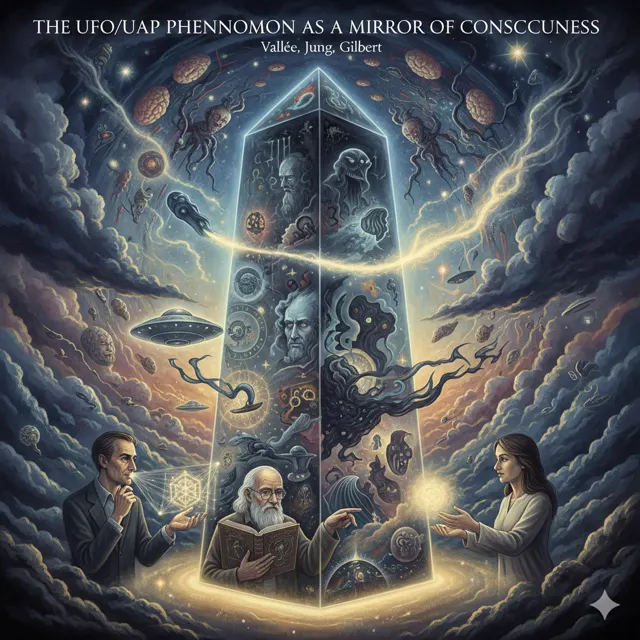
The UAP Phenomenon As A Mirror Of Human Consciousness
Reflections Based Upon Jung, Vallee and Gilbert
Abstract
This essay explores the proposition that the UFO/UAP phenomenon might behave like an agent of transformation in the progressive evolution of human consciousness. It will consider whether the phenomenon acts like a control mechanism or a mirror of our collective human consciousness, awakening us to greater potential, and facilitating an expansion of the individual and collective psyche. It brings together the insights of scientist, polymath, and long seasoned UFO researcher, Jacques Vallée – who coined idea of the UFO as a control mechanism, affecting human evolution. We will consider the insights and wisdom of the founder of analytic psychology, Carl Jung about the individual and collective human psyche and the integration of Jung’s concept of the Shadow into both the individual and collective. We examine how Jung might elucidate upon Vallée’s control mechanism hypothesis. We will consider the ground-breaking work of Dr Paul Gilbert which focuses on integrating the quality of compassion into psychological growth and how compassion might act as an agent of consciousness transformation. Through exploring these three ideas we will use these to elucidate on Vallée’s hypothesis of the UAP phenomenon as control mechanism. The value of interpreting Vallée’ hypothesis through a Jungian framework is that it might help us to understand deeper dimensions of Vallée’s metaphysical view through Jung’s psychoanalytic depth. By introducing the evolutionary power of compassion as a corrective to fear and trauma sometimes evoked by the UFO narrative, we consider our becoming partners and actors in evolution not subjects of an external power. Together, these perspectives invite consideration of the UFO phenomenon not as alien intrusion, but possibly a mirror that reflects back to us, the state of the collective shadow to facilitate our movement into the conscious human evolution
The UFO/UAP Phenomenon as a Mirror of Consciousness
I have often wondered whether the UFO phenomenon might represent something so profoundly different to our usual stereotypical conceptions of it that our explanations barely touches the sides of its reality. Perhaps it is not simply about visitations from elsewhere in the cosmos, but an encounter with something deeply woven into consciousness itself; something that resists literal interpretation.
This resonates with Jacques Vallée’s control mechanism hypothesis. Vallée proposed that the UFO phenomenon operates as a kind of reality mediating system, employing absurd or paradoxical confusing information which somehow challenges our ordinary human perception and in some manner facilitates our growth in consciousness. If the phenomenon functions through symbolic and often disruptive encounters, it may be less a matter of extraterrestrial intrusion and more a catalytic process arising from within consciousness itself, guiding human awareness toward new stages of understanding.
“My personal contention is that the phenomenon is the result of an intelligence, that it is a technology directed by an intelligence, and that this intelligence is capable of manipulating space and time in ways that we don’t understand… The essential conclusion I’m tending to is that the origin of the phenomenon of the intelligence is not necessarily extraterrestrial. I think we are dealing with something that is both technological and psychic and seems to be able to manipulate other dimensions.”
(Vallée, J., & Hynek, J. A. (1975)).
In this light, the phenomenon could function as a metaphysical mirror, reflecting and responding to humanity’s evolving psyche. Like the Monolith in 2001: A Space Odyssey, it may appear at pivotal moments to stimulate psychological, technological, and spiritual growth. I remain sceptical that the phenomenon represents travellers from distant systems such as Zeta Reticulii. Rather, I sense it reveals something far more intimate and profound like a reflection of the depth and complexity of the human soul in dialogue with mystery itself.
To explore these ideas further, it is helpful to turn to the pioneering work of Carl Gustav Jung (1875–1961).
Carl Jung and the Collective Unconscious
The work of Carl Gustav Jung, the Swiss psychiatrist and founder of analytical psychology is a rich foundation of psychological, psychosocial and psychospiritual wisdom. Though initially a collaborator of Freud, Jung’s journey led him toward exploring the symbolic and spiritual depths of the human psyche (Jung, 1959, CW 9[I]). He proposed that beneath our ordinary consciousness lies a vast shared reservoir, the collective unconscious, containing archetypes and universal patterns that shape human myths, dreams, and cultural narratives.
For Jung, each person is called to the lifelong process of individuation, a gradual movement toward wholeness. This journey invites us to attend to dreams, imagination, and symbolic experience as pathways through which the deeper self-communicates. The psyche, he believed, is not merely psychological but sacred terrain; a meeting place between the human and the transcendent.
The Shadow and Collective Projection
Jung warned that what remains unconscious will inevitably find expression in distorted or destructive forms (Jung, 1959, CW 9 [II], para. 13). When individuals or societies repress their fears, desires, and moral contradictions, these denied aspects are projected outward into the world (Jung, 1964, CW 10).
This principle, Jung suggested, helps explain the unfolding of history itself. In his reflections on early twentieth‑century Europe, he proposed that Adolf Hitler embodied the collective shadow of the German people; the unacknowledged destructive forces that had gathered in the national unconscious (Jung, 1964, CW 10; Samuels, 1993). When the collective shadow is projected rather than confronted, it can manifest as social movements of domination, cruelty, or fanaticism. Jung’s insights remain a sober reminder that what we refuse to face inwardly can reappear outwardly with terrible force (Stein, 1998).
Across history, institutions of religion, law, economics, and global enterprise have often acted out of the unexamined collective shadow, causing deep wounds to humanity (Singer & Kimbles, 2004). This has been expressed through manipulation, exploitation, violence, and psychological coercion. When power operates without self‑awareness, especially within hierarchical or patriarchal systems, harm can become systemic (Jung, 1964, CW 10; Singer & Kimbles, 2004). The suppressed shadow within these structures continues to shape human behaviour in ways that diminish, rather than uplift, human dignity.
Something within the present‑day zeitgeist appears, on one hand, to invite culture toward inclusivity and compassion; yet on another level, there remains strong resistance from far‑right and ultranationalist movements towards insularity, othering and scarcity. This tension is an example of the ongoing struggle between emerging consciousness and the collective shadow of fear and division
(Samuels, 1993; Stein, 1998).
The Collective Shadow and the Abduction Phenomenon
Viewed through a Jungian lens, the UFO or UAP abduction reports may be understood as powerful metaphors—or even manifestations of the process of making the shadow conscious in direct and dramatic ways. The phenomenon seems to operate across several domains: psychological, physical, psychic, and spiritual. Thus, the so‑called alien abduction archetype might not signify visitors from another planet but an expression of the collective shadow, dramatized in physical and visionary form.
These accounts often oscillate between fear and revelation. Some describe dark, manipulative, and traumatic experiences as found in the work of the late Dr Karla Taylor (1992), describing frightening night time visitations, poltergeist activity and forced physical examinations. Other accounts recount very contrasting experiences of benevolent, transformative, and spiritual encounters. This duality suggests that the phenomenon acts as a mirror reflecting both light and darkness within the human psyche—a symbolic theatre where humanity’s deepest hopes and fears come face to face.
Jacques Vallée and the Control Mechanism Hypothesis
This interpretation resonates intriguingly with Jacques Vallée’s control mechanism hypothesis. Vallée proposed that the UFO phenomenon may function as a reality‑mediating system, using paradoxical and absurd manifestations to challenge human perception and provoke growth in consciousness. If the phenomenon operates through symbolic and disruptive encounters, it may be less a matter of extraterrestrial intrusion and more a process arising from within consciousness itself, guiding human awareness toward new levels of understanding (Vallée & Hynek, 1975).
“My personal contention is that the phenomenon is the result of an intelligence, that it is a technology directed by an intelligence, and that this intelligence is capable of manipulating space and time in ways that we don’t understand… The essential conclusion I’m tending
to is that the origin of the phenomenon of the intelligence is not necessarily
extraterrestrial. I think we are dealing with something that is both
technological and psychic and seems to be able to manipulate other dimensions.”
(Vallée in Vallée & Hynek (1975, The Edge
of Reality))
Power, Projection, and the Shadow’s Temptation
Such a framework might also illuminate the patterns of occultists in history like the late Allister Crowley, certain contemporary esoteric movements, or even elite power structures, which have sought to harness unseen forces for control or influence. If, as Jung’s theory implies, and Vallee’s theory suggests, the phenomenon might externalise deep layers of the unconscious, it is conceivable that some actors might arrogantly believe themselves capable of exploiting this unseen energy for personal gain. There has been speculation that the recent redacted Epstein Files released by the US government, may contain details of Epstein having a morbid fascination with the occult. Time will tell.
Yet from a Jungian or spiritual perspective, such efforts risk profound consequences. To use consciousness for avaricious personal gain can invite psychological and spiritual fragmentation. If Vallée’s control mechanism is a metaphysical intelligence or an emergent property of the
collective psyche, its purpose may ultimately be developmental rather than
exploitative; a means of guiding humanity toward greater self‑awareness, moral
maturity, and spiritual integration (Vallée, 1989, 1990).
If the phenomenon is intertwined with consciousness then attempts to dominate it for egoic or materialistic ends could yield what might be called spiritual blowback: an ontological reckoning beyond the reach of power or technology.
Compassion as Evolutionary Impetus
What can help humanity to propel its own psychosocial and psychospiritual evolution today? An emergent property of the collective psyche which I have noticed arising is the power of compassion as a philosophical and social movement; a primary ethical position and a powerful quality of being mediated through practices such as mindfulness. Paul Gilbert’s book Living Like Crazy (2012) invites us to pause amid the relentless noise of modern life and to notice how fear, ambition, competition, and comparison often compete to rule the human heart. Gilbert argues that evolution did not prepare us to live with the speed, anxiety, and performance pressure of modern societies. Our ancient nervous systems, once tuned for survival in cooperative communities, now react to continuous threat and competition.
The antidote, he teaches, is compassion. This is the courageous capacity to face suffering, within ourselves and others, with understanding and care. Compassion awakens the body’s and psyche’s soothing system, creating inner safety from which caring and creativity can flow. Whenever we offer steady, non‑judgmental caring presence to another, we can help to regulate theirs and our own, sympathetic nervous systems, catalysing in to action our parasympathetic system to bring safety, calm and a sense of connection.
Gilbert’s message is profoundly spiritual: humanity’s next evolutionary step is not technological or economic, but ethical and relational. To move from living like crazy to living with compassion is to join a deeper transformation that restores us to what is most sacred in being human.
Integrating Gilbert, Jung, and Vallée
In their own disciplines, Gilbert, Jung, and Vallée converge on a central tenet:
humanity is an evolutionary entity, which can potentially evolve for the good
of the species or against its own best interests.
Gilbert reminds us that compassion balances our internal systems of threat,drive,and soothing guiding us toward a space where calm, wisdom, courage, empathy, strength and caring can arise. Jung shows that compassion can arise by bringing the repressed aspects of our shadow into consciousness and allowing its integration into the psyche rather than its projection. Gilbert would suggest that compassionate dialogue between the various parts of the self can restore wholeness where fear divides the psyche. Vallée touches into compassion within the metaphysical; the capacity to approach the unknown without fear and suspicion but with curiosity and analysis and to consider the possibly that the phenomenon might be encounter rather than invasion. From these insights I would suggest that the UFO/UAP phenomenon, and indeed the crises and opportunities of our age, may not be puzzles to conquer but mirrors inviting reflection. They may reveal both our collective shadow and our potential for transcendence.
Rather than pointing us toward control and certainty, the phenomenon may beckon us toward a more tentative, curious position, helping us to learn to develop a tolerance of uncertainty. In that light, it might become part of humanity’s unfolding dialogue with the unknown; a reminder that consciousness itself is both the question and the answer, and that compassion is very possibly its next form of evolution.
References
Gilbert, P. (2012). Living Like Crazy.
London, UK: Constable & Robinson.
Jung, C. G. (1959). Aion: Researches into
the Phenomenology of the Self (Collected Works Vol. 9 [II]). Princeton
University Press.
Jung, C. G. (1964). Civilization in
Transition (Collected Works Vol. 10). Princeton University Press.
Samuels, A. (1993). The Political Psyche.
Routledge.
Singer, T., & Kimbles, S. L. (Eds.). (2004).
The Cultural Complex: Contemporary Jungian Perspectives on Psyche and Society.
Routledge.
Stein, M. (1998). Jung’s Map of the Soul: An
Introduction. Open Court.
Vallée, J. (1989). Dimensions: A Casebook
of Alien Contact. Anomalist Books.
Vallée, J. (1990). Confrontations:
A Scientist’s Search for Alien Contact. Ballantine Books.
Vallée, J., & Hynek, J. A. (1975).
The Edge of Reality: A Progress Report on Unidentified Flying Objects.
Chicago, IL: Henry Regnery.
Turner, K.
(1992). Into the fringe: A true story of alien abduction. Berkley Books.