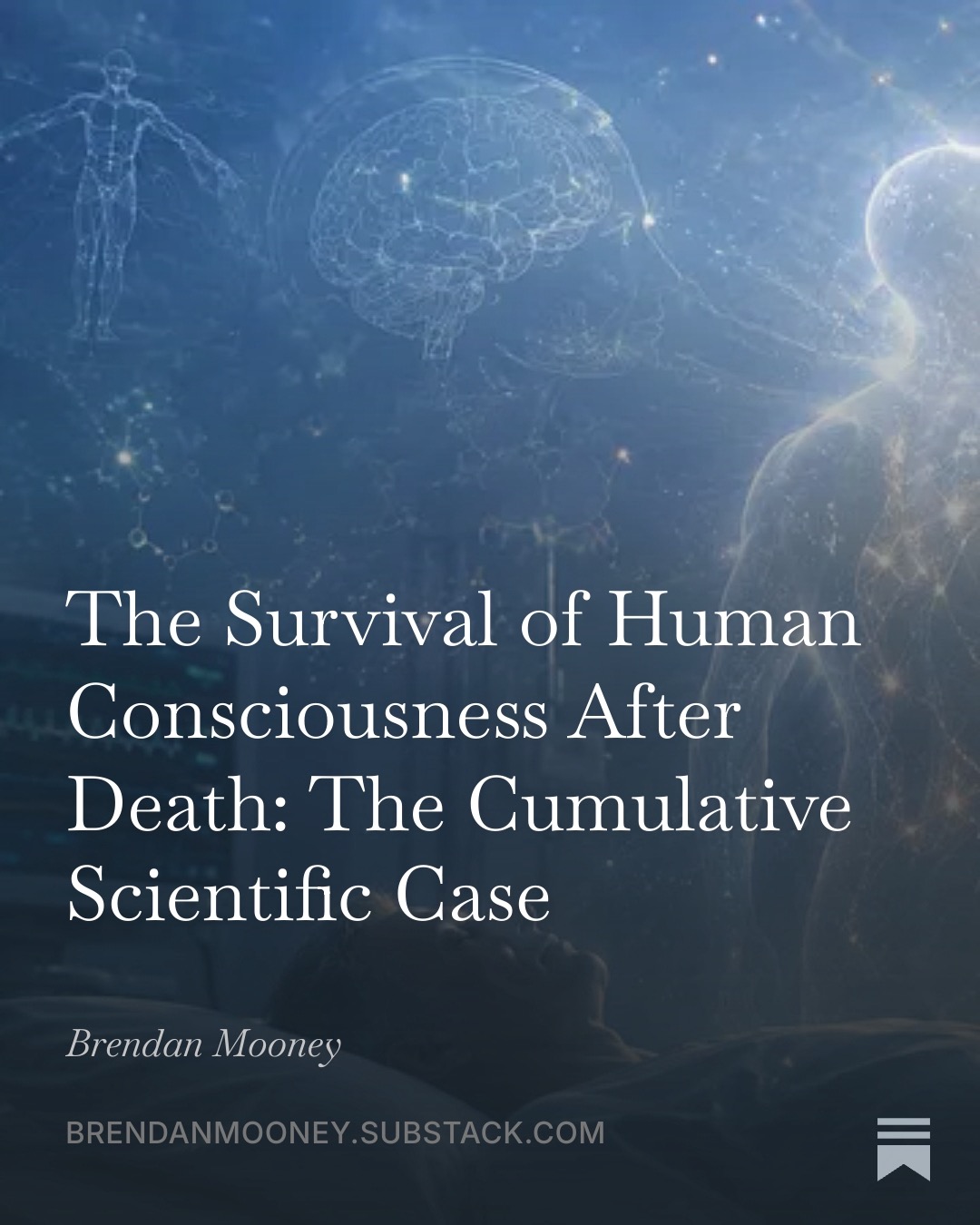
The Survival of Human Consciousness After Death: The Cumulative Scientific Case
For most of the modern scientific era, the proposition that human consciousness survives bodily death has been treated primarily as a matter of religious belief rather than empirical knowledge. The prevailing materialist assumption has been that the brain produces consciousness and that, when the brain dies, consciousness necessarily ceases with it. Yet what science has firmly established is a profound correlation between brain function and conscious experience. It has not established that the brain creates consciousness, nor has it demonstrated that consciousness cannot exist independently of it.
Over the past half century, research into near death experiences, deathbed phenomena, terminal lucidity, mediumship, reincarnation memories in children, spontaneous after death communications and related anomalous experiences has produced a remarkably consistent picture. Consciousness appears capable of functioning when the ordinary mechanisms of the brain are severely compromised. People sometimes acquire information beyond normal sensory channels, while aspects of memory and identity appear capable of persisting beyond the death of the physical body (van Lommel et al., 2001; Long and Perry, 2010; Fenwick and Fenwick, 2008; Tucker, 2008).
Taken cumulatively, this evidence supports the conclusion that the survival of consciousness after bodily death is no longer merely speculative. The evidence is substantial, diverse and deserving of serious consideration. This paper will examine some of the most important areas of research while also considering the lived experiences of people who have encountered these phenomena directly. These include people who have undergone near death experiences, children whose apparent memories of previous lives have subsequently been verified, dying patients who have reported seeing deceased relatives or experiencing themselves outside their bodies, and bereaved people who have described apparitions, meaningful synchronicities and unusual physical phenomena associated with those who have died.
This essay examines that evidence alongside experiences drawn from my own personal and professional life. Having spent many years working in oncology, palliative care, psychotherapy and hospice chaplaincy, I have encountered patients and bereaved people who have described experiences that closely resemble those documented in the research literature. By bringing together scientific investigation, clinical observation and personal experience, this essay argues that the evidence is best understood not as a collection of isolated anomalies, but as a converging body of evidence that human consciousness survives the death of the body.
A Personal Catalyst to Exploration
My professional background spans thirty four years, including twenty years in social work and fourteen years as a psychotherapist. Of those thirty four years, twenty three have been spent working in oncology and palliative care. I am also an ordained priest in the Open Episcopal Church and, for three years, worked part time as a hospice chaplain alongside my psychotherapy work at another hospice. Consequently, death, dying, bereavement and the psychological and spiritual questions surrounding them have formed a significant part of both my professional and personal life.
My own journey into investigating consciousness beyond physical death began after the death of my mother in January 2007. My father had died from colorectal cancer in December 2005, and my mother had cared for him throughout his illness. She was a strong minded Irish woman who had emigrated to the United Kingdom in the 1950s at the age of fifteen. She had exaggerated her age in order to find employment and, once here, worked extremely hard. Life was not easy for Irish immigrants at that time, but her determination to build a life for herself remained undiminished.
During the final thirteen months of her life, my mother was beset by a number of complex health conditions that resulted in several hospital admissions. She underwent surgery for arterial disease and remained under the care of several healthcare specialists. My sister, a close and dear friend, and I were all deeply involved in caring for and supporting her. By around September 2006, her health seemed to have stabilised somewhat and we felt a welcome sense of relief. I hoped that she might finally enjoy some respite and a degree of normality after the death of my father, for whom she had been such a diligent and devoted carer.
In November 2006, however, we began to notice troubling changes. She was losing weight and experiencing memory difficulties, bloating after eating, physical unsteadiness, changes in personality and a profound emotional vulnerability. I remember one evening having to wash her feet with a specially prescribed solution after she developed MRSA in the swollen and deteriorating skin. She suddenly broke down in tears and told me how unworthy she felt. Hearing my mother speak of herself in this way broke my heart.
She was admitted to hospital in the middle of November because of anaemia. Following a series of X rays, scans and blood tests, she was diagnosed with widespread metastatic cancer, including metastases to the brain. Even now, writing these words brings the emotion of that time back vividly.
A few days before she died, Mum surprised me by saying something completely unexpected. She looked at me and said, “I will always be with you both” (my sister and I). It was not the sort of statement she would ordinarily have made, and I remember being speechless. At the time, I had no idea how significant those words would later become. We made her final Christmas as peaceful and loving as possible. Her anxiety about dying was palpable and we continued caring for her at home until she died on 17 January 2007.
My Lucid Dream
Only days after our mother died, I had the most extraordinary dream. I was sitting in the back room of my parents’ house. Mum was seated in her familiar armchair beside the window while Dad was sitting next to me on the sofa. There was an extraordinary clarity to the experience. I knew that I was dreaming, yet simultaneously understood that this was somehow not an ordinary dream. I looked at my mother and said, “This isn’t a dream, is it?” She smiled. I looked across at Dad and the overwhelming sense that something extraordinary was occurring was unmistakable.
A few weeks later I returned to my work at the NSPCC, having previously spent two and a half years at St Christopher’s Hospice as a specialist clinical social worker. Following my father’s death, I had felt a strong need to step away from palliative care for the sake of my own emotional wellbeing. In retrospect, I am very glad that I did. I do not think I could have continued working with dying patients while facing a second parental bereavement so soon after the first.
One of my dearest colleagues, who subsequently became a very close friend, asked me one day how I was coping. Her simple kindness led me to tell her about the lucid dream. When I had finished, she looked at me very seriously. She was a seasoned probation officer who had worked with some extremely dangerous offenders and was very much a practical, no nonsense person. My immediate thought was, “Oh God, she is going to think I am crazy.”
Instead, she told me something remarkable. After her own mother had died, following three weeks during which my colleague had sat beside her in a hospice, her mother appeared to her a few days later on the garden path leading towards her house. She saw her clearly. Her mother briefly commented on the flowers and then vanished. My friend entered the house stunned. Only a few minutes later, the telephone rang. It was her brother. His first words were, “You won’t believe what just happened.” He then described experiencing their mother at precisely the same time.
That conversation stayed with me. It was not merely because somebody I respected had reported seeing her dead mother. The remarkable feature was the apparent simultaneity of the experience. Two bereaved siblings, in different places, appeared to encounter the same deceased person at the same time. It was one of my first encounters with what the literature would describe as an after death communication, although at that point I knew nothing about the terminology or the research.
An increase in sensitivity.
Since childhood I have had a type of natural sensitivity. I rarely shared experiences related to this with others. It included at times seeing auras around the human body, precognitive dreams, picking up information about a person in conversation (and then hearing them confirm it later in the course of the conversation) and even occasionally seeing what seemed like spirit forms and orbs. It’s not the kind of thing to share in ordinary conversation. My empathic nature has always been heightened. However, I began to notice extraordinary phenomena increase in the months after mum’s death.
In the spring I decided to attend a public demonstration of mediumship at the Spiritualist Association of Great Britain in London. I knew virtually nothing about mediumship or Spiritualism, but something within me felt compelled to open a door and discover what might lie beyond it.
The medium was Billy Cook. I did not know at the time that he was well respected within Spiritualist circles. I was sitting among approximately fifteen to twenty other people when he turned towards me and said that he had a woman with him, a mother figure, who was Irish and had died recently. These details were correct, but I remained silent and deliberately gave nothing away. He then said, “Her name is Mary.” Again, correct. He described her becoming seriously ill over a short period and said that her final week had been extremely difficult and that passing into spirit had brought relief. He then gave the names William, Joe and Terry with whom she was reunited. Terry (Terence) was my father’s name. William was my mother’s brother, and Joe was her brother in law, of whom she had been particularly fond.
Approximately two months later I attended a large Mind, Body and Spirit Festival at which the Scottish medium Gordon Smith was demonstrating mediumship. During the demonstration, Gordon indicated that he wished to speak to me. He said that he had a woman with him from Ireland whose name was Mary. He identified her as my mother. He described how she had become very ill very quickly and said that passing into spirit had brought relief (again). He then referred specifically to my washing her feet. This was an intensely private detail from the final weeks of her life.
Gordon also gave the names of family members who had already died (including two of the names Billy had given). However, things became much more specific. He said there was another woman my mother had known, also named Mary, who had died at around the same time as mum. This was true. Mary was an Irish friend of mum’s who lived locally. We had all known Mary and her family for years. We knew her daughter well and were aware that Mary’s illness was advancing. Mary had died approximately two weeks before mum. What followed next surprised me even more. Gordon said that my mother had been happily reunited with a good friend called Betty. He said that I had known this woman as a young child. He was correct. Betty had experienced serious mental health difficulties. I remembered visiting her with mum when she was an inpatient at a mental health hospital following a breakdown. She had sadly died following an overdose. Beyond my comprehension, Gordon then supplied her surname.
These experiences transformed my interest in survival from an abstract philosophical question into a serious personal enquiry. I had already spent two and a half years professionally accompanying people through incurable illness, dying, bereavement and profound psychological distress. In the course of that work, dying people had sometimes spoken to me of experiences that seemed to transcend conventional expectations. I later returned to work in palliative care from early 2008 – following a significant push to return to this work. The accumulation of experiences I have heard since then have been phenomenal: patients leaving their bodies; witnessing deceased parents, spouses or siblings who had appeared at their bedside, sometimes with the clear impression that these relatives had come to reassure them or accompany them. Bereaved people also described seeing the person who had died, experiencing extraordinary synchronicities, or encountering physical phenomena involving objects strongly associated with the deceased.
These narratives were not generally told theatrically. Often they were disclosed hesitantly, as though the person were testing whether it was safe to tell me. What struck me repeatedly was the normality of the people describing them and the conviction that what had happened was qualitatively different from imagination. I would later discover that this closely reflected findings in research on both end of life experiences and after death communications (Fenwick and Brayne, 2011; Kamp et al., 2020).
What began with grief therefore became an enquiry. The question was no longer simply whether I wished to believe that my mother had survived death. It was whether consciousness itself continues after the death of the body and whether the experiences I was hearing in clinical practice, witnessing in my personal life and discovering in the scientific literature were different manifestations of the same underlying reality.
Elisabeth Kübler Ross and an Encounter with a Deceased Patient
Dr Elisabeth Kübler Ross was a Swiss American psychiatrist and one of the foremost pioneers in the modern study of death, dying and bereavement. Through her work with terminally ill patients, she challenged the medical profession’s reluctance to speak openly about death and insisted that dying people should be listened to with honesty, compassion and dignity. Her landmark book On Death and Dying transformed professional and public discussion of dying and introduced what became widely known as the five stages associated with dying and grief: denial, anger, bargaining, depression and acceptance (Kübler Ross, 1969). Later in her career, her work with dying patients, her engagement with near death experiences and her own personal experiences convinced her that consciousness survives physical death (Kübler Ross, 1991).
One of her most striking accounts concerned a former patient, Mrs Schwartz. Kübler Ross described reaching a point at which she had decided to give up her work on death and dying. After one of her seminars at the University of Chicago, she encountered Mrs Schwartz, whom she knew had died approximately ten months previously. The woman accompanied her to her office and urged her not to abandon her work. Kübler Ross, struggling to comprehend what was happening, asked Mrs Schwartz to write and sign a note. According to Kübler Ross, she did so before leaving. Kübler Ross subsequently described retaining the note. The experience had a profound effect upon her and strengthened her conviction that death did not extinguish personal consciousness (Kübler Ross, 1991).
Her experience is particularly relevant because it resembles narratives I have heard from bereaved people throughout my professional life. Apparitions of the dead do not necessarily occur during altered states or in people seeking paranormal experiences. They may occur spontaneously during ordinary waking consciousness and can possess a quality of reality that the experiencer finds difficult to dismiss. Kübler Ross’s experience is unusually striking because she reported an extended interaction, purposeful communication and an apparent physical trace in the form of handwriting.
Near Death Experiences: Consciousness at the Boundary of Death
The most extensive modern evidence for survival comes from near death experiences, or NDEs. These commonly occur during cardiac arrest, catastrophic injury, profound unconsciousness or other medical crises. Their recurring features include unusually lucid consciousness, separation from the physical body, perception of the surrounding environment from an elevated position, movement through darkness or a tunnel, encounters with intense light, meetings with deceased relatives, panoramic life reviews and entry into a realm frequently experienced as more real than ordinary waking life (Greyson, 1983; Long and Perry, 2010).
Dr Jeffrey Long, an American radiation oncologist and founder of the Near Death Experience Research Foundation, has assembled one of the world’s largest collections of detailed NDE accounts. In Evidence of the Afterlife: The Science of Near Death Experiences, written with Paul Perry, Long presents a number of converging lines of evidence. These include heightened consciousness at a time of severe physiological impairment, apparently accurate perceptions during out of body experiences, NDEs under general anaesthesia, experiences reported by blind people, encounters with deceased relatives, similar experiences among young children, worldwide similarities and enduring changes in the lives of experiencers (Long and Perry, 2010).
This evidence is strengthened by prospective hospital research. In 2001, Dutch cardiologist Pim van Lommel and colleagues published a landmark study in The Lancetinvolving 344 successfully resuscitated cardiac arrest patients in ten Dutch hospitals. Sixty two patients, approximately 18 per cent, reported an NDE, with forty one describing what the researchers classified as a core experience. The occurrence of the experience was not adequately accounted for by factors such as duration of cardiac arrest, medication or fear of death immediately before the arrest. The significance of cardiac arrest is obvious: normal cerebral circulation is abruptly and profoundly disrupted, yet some patients subsequently report coherent, structured and exceptionally vivid conscious experiences (van Lommel et al., 2001).
Dr Sam Parnia’s AWARE programme has taken the investigation further. The AWARE II study involved 567 in hospital cardiac arrests across twenty five sites. Fifty three people survived and twenty eight completed interviews, of whom eleven reported memories or perceptions suggestive of consciousness during cardiac arrest. The study also recorded EEG activity during resuscitation, demonstrating that organised electrophysiological activity can occur during prolonged cardiopulmonary resuscitation (Parnia et al., 2023). This work has significantly expanded scientific investigation into the relationship between cardiac arrest, consciousness and the dying process.
Bruce Greyson, psychiatrist and longstanding researcher at the University of Virginia, has also played a central role in establishing NDEs as a legitimate field of systematic study. His Near Death Experience Scale provided researchers with a standardised means of identifying and comparing NDEs (Greyson, 1983). Particularly significant within the wider literature are cases involving apparently veridical perception and encounters with people whose deaths were unknown to the experiencer at the time.
The importance of this research resonates strongly with what I have heard from patients during my own work in oncology and palliative care. Over the years, dying people have occasionally described experiences of being outside their bodies or of observing themselves and their surroundings from another perspective. Such disclosures can occur very quietly within an ordinary clinical conversation. The striking feature is frequently not drama but lucidity. People may speak calmly and matter of factly about something that sits completely outside conventional medical expectations. When these accounts are placed alongside the thousands of cases studied by NDE researchers, they no longer appear to be isolated curiosities. They become part of a recognisable phenomenology occurring across different cultures and clinical settings (Long and Perry, 2010; Greyson, 1983).
Pam Reynolds and Veridical Perception
One of the most striking examples of a veridical NDE is the case of Pam Reynolds, who underwent an extraordinary neurosurgical operation in 1991 for a giant basilar artery aneurysm. During the most extreme stage of the procedure her body temperature was reduced to approximately 15.5 degrees Celsius, her heart was stopped, circulation through her brain ceased and her neurological activity was intensively monitored. Cardiologist Michael Sabom subsequently investigated her account in detail (Sabom, 1998).
Before the deepest stage of circulatory arrest, while profoundly anaesthetised with her eyes taped shut and auditory monitoring equipment in her ears, Reynolds later reported perceiving the operation from outside her body. She accurately described the unusual surgical instrument used to open her skull and recalled a conversation concerning difficulties encountered with blood vessels required for the bypass procedure. During the wider experience she described separation from her physical body and encounters with deceased relatives (Sabom, 1998).
The chronology is important. The veridical observations concerning the surgical equipment and conversation occurred before the period of complete circulatory arrest. Nevertheless, they occurred while Reynolds was deeply anaesthetised and her normal sensory access was severely restricted. The case remains significant because reported conscious perception corresponded with identifiable events taking place in the physical environment (Sabom, 1998). It exemplifies the aspect of NDE research that is most difficult to reduce to a purely internal hallucination. An internally generated experience might account for tunnels, lights or even deceased relatives, but it becomes far more difficult to invoke that explanation when the experiencer returns with accurate information concerning events that occurred while ordinary perception was profoundly compromised.
The Transformative Effects of Near Death Experiences
One of the most revealing aspects of near death experiences is the profound and frequently enduring transformation of those who undergo them. Experiencers often report a dramatic reduction in fear of death, greater compassion, diminished materialism, a stronger sense of moral purpose and a lasting conviction that consciousness continues beyond bodily death (van Lommel et al., 2001; Long and Perry, 2010).
The significance of this transformation lies in the way experiencers themselves understand what happened. Many do not describe the NDE as resembling a dream. They insist that it possessed an exceptional quality of clarity and reality. Their conviction that death is not the end does not arise principally from theological teaching or intellectual argument but from having experienced themselves as conscious apart from their physical bodies (Long and Perry, 2010).
This is also relevant clinically. The fear of death can be profound among people approaching the end of life, yet those who have experienced phenomena of this kind frequently speak about death differently. Their certainty is often experiential rather than doctrinal. As a clinician and priest, I have been struck by the distinction between somebody who says that they believe there may be something after death and somebody who says, in effect, I know because I have experienced it. The emotional quality of those statements is quite different.
Stuart Hameroff and the Nature of Consciousness
Near death research raises a fundamental theoretical question. If consciousness can persist during profound disruption of normal brain function, what is consciousness itself? Dr Stuart Hameroff, an anaesthesiologist at the University of Arizona, and mathematical physicist Sir Roger Penrose developed the Orchestrated Objective Reduction theory, usually known as Orch OR. Their model proposes that consciousness involves quantum processes associated with microtubules within neurons and may connect conscious processes with the fundamental structure of physical reality (Hameroff and Penrose, 2014).
The significance of Orch OR within the present discussion is that it challenges the assumption that consciousness can be fully explained as a by product of classical neuronal computation. Hameroff and Penrose’s work opens the possibility that the brain organises or mediates consciousness through processes that reach much more deeply into the structure of nature (Hameroff and Penrose, 2014). Within such a framework, the destruction of the brain need not automatically equate to the destruction of consciousness.
Peter Fenwick, The Art of Dying and the Experiences of the Dying
The work of British neuropsychiatrist Dr Peter Fenwick is particularly important because it moves the focus from people who almost die and recover to those who are actually approaching death. In The Art of Dying, written with Elizabeth Fenwick, he examines deathbed visions, experiences of light, apparent visitations by deceased relatives, deathbed coincidences and other phenomena reported by dying people, their families and healthcare professionals (Fenwick and Fenwick, 2008).
Research by Fenwick and Sue Brayne found that end of life experiences are not uncommon and that reports of deceased relatives, meaningful coincidences and other unusual phenomena form a recognisable part of the dying process. Healthcare professionals reported phenomena including visions, unusual coincidences, experiences involving light and events surrounding the moment of death. Importantly, clinicians often distinguished these experiences from drug induced confusion or delirium and described patients as lucid when the experiences occurred (Fenwick and Brayne, 2011).
These findings are particularly significant because dying people frequently describe seeing deceased relatives who appear to have come to accompany them. Such experiences are often coherent, emotionally meaningful and reassuring rather than frightening or disorientating (Fenwick and Fenwick, 2008; Fenwick and Brayne, 2011).
This research has particular resonance for me because it closely resembles experiences described by patients during my own years in oncology, hospice and palliative care. I have listened to dying people speak about deceased family members being present in the room, sometimes describing those relatives with complete calm and familiarity. Others have spoken of being outside their bodies or of having travelled somewhere and returned. These accounts are frequently disclosed without any intention of proving anything. The patient is simply describing what he or she has experienced.
There is also a distinctive quality to many of these encounters. They do not necessarily resemble the agitation and disorientation associated with delirium. A person may be entirely coherent, recognise those physically present and simultaneously speak of a deceased parent, spouse or sibling whom they can apparently perceive. Sometimes the experience brings profound comfort. The deceased are not perceived as frightening intrusions but as familiar figures whose presence seems to reassure the dying person that they will not make the transition alone. This closely parallels the patterns identified by Fenwick and colleagues in systematic studies of end of life experience (Fenwick and Brayne, 2011).
For me, Fenwick’s research is therefore not an abstract collection of unusual reports. It describes phenomena I have encountered within clinical practice. Scientific studies provide the wider pattern and systematic documentation; clinical experience supplies the human context in which these experiences actually occur.
Terminal Lucidity
Closely related to deathbed phenomena is terminal or paradoxical lucidity. This refers to the unexpected return of coherent awareness shortly before death in some people who have been profoundly cognitively impaired. Individuals who may not have recognised relatives or communicated meaningfully for considerable periods can suddenly become alert, converse appropriately and appear once more recognisably themselves.
Terminal lucidity challenges a simplistic identification of the person with the current functional state of the brain. If the neural structures responsible for memory and personality have been severely damaged, the unexpected reappearance of coherent personality immediately before death raises profound questions about the relationship between consciousness and cerebral function. Within a model in which the brain mediates consciousness rather than creates it, the phenomenon becomes more intelligible.
Scientific Studies of Mediumship
If NDEs suggest that consciousness can function apart from its ordinary bodily conditions, mediumship addresses the more direct question of whether an identifiable individual continues after permanent physical death. Mediumship has undoubtedly attracted fraud and poor practice throughout its history, but that fact makes controlled research more important rather than less.
Dr Gary Schwartz, a psychologist at the University of Arizona, established the VERITAS Research Program to investigate whether individual consciousness and identity survive physical death. His work, described for a wider readership in The Afterlife Experiments, involved increasingly controlled experiments in which mediums attempted to provide specific information about deceased individuals (Schwartz and Simon, 2002). Some experimental protocols prevented mediums from seeing the sitter, required the sitter to remain silent or separated the sitter from the medium entirely.
Later research by Dr Julie Beischel and colleagues employed increasingly stringent blinded protocols. In one triple blind experiment, sitters were absent during the readings, mediums were blind to the identity of both the sitter and the deceased person, and the experimenter interacting with the medium was also blind to the relevant information. Intended readings subsequently received significantly higher ratings than control readings (Beischel and Schwartz, 2007). Later replication and extension studies again reported anomalous information reception under blinded conditions (Beischel et al., 2015).
The importance of such experiments lies in eliminating ordinary explanations such as reading facial expressions, responding to tone of voice or extracting information through conversational feedback. When the medium cannot see the recipient, the recipient is not present during the reading and the experimenter does not possess the relevant information, conventional cold reading becomes an increasingly inadequate explanation.
Allison DuBois and Gary Schwartz
Schwartz’s investigations included several years of work with the American medium Allison DuBois, who later became the inspiration for the television series Medium. Schwartz regarded DuBois as one of the more impressive mediums he had tested and described his experimental work with her in The Truth About Medium (Schwartz and Simon, 2005).
In one reported experiment, DuBois attempted to provide information concerning the deceased husband of a woman living in England while possessing very limited information about the living recipient. The transcript was subsequently assessed by the widow and was reported as containing a high proportion of accurate information (Schwartz and Simon, 2005). The significance of such experiments is not the celebrity subsequently associated with DuBois but the question of whether detailed and personally meaningful information could be obtained when normal routes of communication had been restricted.
Gordon Smith and the Robertson Roy Research
The Scottish medium Gordon Smith was subjected to sustained investigation through the work of Professor Archie Roy and researcher Tricia Robertson. Their research addressed one of the standard criticisms of mediumship: that apparently impressive statements are actually broad generalisations that could apply to almost anybody.
Robertson and Roy compared the degree to which intended recipients accepted mediumistic statements with the degree to which people for whom those statements were not intended accepted them. Their initial study involved ten mediums, forty four recipients and hundreds of non recipient assessments. The intended recipients accepted significantly more of the material as relevant to themselves than did comparison participants (Robertson and Roy, 2001). Further work developed these procedures into what became known as the Robertson Roy protocol (Robertson and Roy, 2004).
This research holds particular personal significance because my own experience with Gordon Smith reflected precisely the quality that Robertson and Roy were attempting to measure: specificity. Gordon did not merely offer general statements about grief or say that my mother loved me. He supplied her name, her Irish background, the rapid course of her illness, the detail of my washing her feet, the existence of another Mary who had recently died, the childhood connection with Betty and finally Betty’s surname. For me, the laboratory research and personal experience therefore intersect. The research asked whether Smith could produce information specifically relevant to the intended recipient; my encounter with him provided an intensely personal example of that very phenomenon.
Ian Stevenson, Jim Tucker and Memories of Previous Lives
Perhaps the most striking evidence for survival is found in young children who spontaneously describe apparent memories of previous lives. Dr Ian Stevenson of the University of Virginia devoted decades to investigating these cases, and his work has subsequently been continued by Dr Jim B. Tucker and colleagues at the university’s Division of Perceptual Studies.
More than 2,500 cases have been investigated. Children typically begin speaking about an apparent previous life at around two or three years of age, with the memories often fading by the age of six or seven. They may provide names, locations, occupations, family relationships and details concerning the manner of death. In many cases, investigators have subsequently identified a deceased individual whose life corresponds closely with the child’s statements (Tucker, 2008).
An especially remarkable feature of Stevenson’s research concerns birthmarks and birth defects corresponding with injuries suffered by the deceased individual whom the child appears to remember. Stevenson investigated hundreds of such cases, including cases in which the alleged correspondence could be checked against medical or post mortem records (Stevenson, 1997).
One of Tucker’s most widely discussed American cases concerns James Leininger, who from approximately two years of age experienced recurrent nightmares involving a burning aircraft. He subsequently described himself as an American pilot whose aircraft had been shot down by the Japanese, referred to the aircraft carrier Natomaand named Jack Larsen. Investigation eventually identified the USS Natoma Bay and a young pilot, James M. Huston Jr, who had been killed in combat near Iwo Jima in 1945. Particularly important was documentation demonstrating that some of the child’s statements had been made before Huston was identified as the proposed previous personality (Tucker, 2008).
The Stevenson and Tucker cases are significant because they extend the survival question beyond the period immediately surrounding death. NDEs concern consciousness during an encounter with death. Mediumship concerns communication after death. These childhood cases suggest that memories, behavioural tendencies and aspects of individual identity may persist beyond death and become associated with another developing human life.
After Death Communications
A further major category of evidence comes from spontaneous after death communications, usually abbreviated to ADCs. Bill and Judy Guggenheim brought widespread public attention to the phenomenon in their book Hello From Heaven!During approximately seven years of research they collected more than 3,300 firsthand accounts from people who believed they had experienced direct contact with a deceased relative or friend (Guggenheim and Guggenheim, 1996).
Such experiences take many forms. People describe sensing the presence of a deceased person, hearing his or her voice, seeing an apparition, feeling a touch, smelling a distinctive perfume or other familiar scent, experiencing unusually vivid encounters during sleep, or witnessing physical events strongly associated with the deceased.
More recent research demonstrates that such experiences are neither exceptionally rare nor confined to people with psychiatric illness. A major interdisciplinary review concluded that sensory and quasi sensory experiences of deceased people are common in bereavement and that the overwhelming majority appear to be benign rather than pathological (Kamp et al., 2020).
This research is strikingly consonant with what I have encountered professionally. Bereaved people have described apparitions of husbands, wives, parents and children. Others have spoken of a sudden and unmistakable sense that the deceased person was physically close. Some have reported synchronicities occurring at emotionally significant moments, while others have described unusual physical events involving objects associated with the person who died.
These disclosures often emerge only after trust has developed. There can be a palpable fear of ridicule or of having the experience pathologised. As a psychotherapist, I have become increasingly aware of how important it is to allow people to describe such experiences without immediately framing them into a psychiatric framework. The research supports that approach: experiences of deceased people are widespread and are usually experienced as meaningful rather than disturbing (Kamp et al., 2020).
My friend’s experience of seeing her mother on the garden path is especially relevant here. Had she alone experienced the apparition, it might have been interpreted as an intensely vivid bereavement experience. The fact that her brother telephoned moments later and independently reported encountering their mother at the same time adds a dimension that cannot readily be contained within an explanation based solely upon one person’s grief.
My own lucid dream of both my parents also belongs within this wider continuum. Its extraordinary clarity and the conviction that it was more than an ordinary dream closely resemble descriptions found throughout the ADC literature (Guggenheim and Guggenheim, 1996; Kamp et al., 2020). Its importance to me lies not in isolation but in what followed: the experiences reported by my colleague, the information given by mediums, the narratives of dying patients and bereaved clients, and eventually the discovery that similar experiences have been systematically documented on a very large scale.
Electronic Voice Phenomena and Physical Mediumship
Electronic Voice Phenomena, or EVP, refer to apparently anomalous voices captured on electronic recording equipment when no visible speaker is present. This area is more difficult to evaluate because the human brain is highly capable of detecting patterns in ambiguous noise. Auditory pareidolia, environmental contamination and radio interference can create false impressions of speech. The evidential value of EVP therefore depends upon carefully controlled recording environments, blinded assessment and the ability of independent listeners to identify meaningful information without prior prompting.
Physical mediumship occupies similarly controversial territory. One of the best known British examples from recent decades is the Scole Experiment, conducted in Norfolk during the 1990s and investigated by researchers associated with the Society for Psychical Research. Reports described unusual lights, photographic effects, apparent object movements and other physical phenomena occurring during sittings. The field has a complicated history and requires rigorous controls, but the persistence of reported physical phenomena alongside other forms of survival evidence makes continued investigation important.
Does the Brain Produce Consciousness or Transmit It?
All of this evidence ultimately returns us to the central scientific question. The brain and consciousness are intimately related, but relationship does not establish production. Damage to the brain can profoundly alter memory, personality, language or perception, but this establishes that the brain is essential for the expression of consciousness during physical life. It does not establish that the brain generates consciousness in its entirety.
The familiar analogy is that of a radio. Damage the receiver and the music becomes distorted. Destroy the receiver and the music disappears from that particular location. Yet the destruction of the radio has not destroyed the broadcast. The analogy illustrates an important logical distinction: a structure may mediate, filter or transmit something without creating the thing it mediates.
The survival evidence strongly supports such a model of consciousness. Near death experiences show complex consciousness occurring during profound physiological crisis (van Lommel et al., 2001; Long and Perry, 2010; Parnia et al., 2023). Veridical experiences involve information apparently acquired outside ordinary sensory pathways (Sabom, 1998). Terminal lucidity raises questions about the relationship between neurological impairment and the persistence of personal identity. Controlled mediumship research indicates anomalous access to information associated with deceased individuals (Beischel and Schwartz, 2007; Beischel et al., 2015). Reincarnation cases suggest the persistence of memory and identity beyond a single lifespan (Stevenson, 1997; Tucker, 2008), while ADC research suggests continuing interaction between the deceased and the living (Guggenheim and Guggenheim, 1996; Kamp et al., 2020).
Seen separately, each phenomenon can be challenged with a different conventional explanation. Seen together, they are strikingly coherent.
The Argument from Convergence
The strongest case for survival does not depend upon any one experiment, researcher or extraordinary story. Its power lies in convergence. Near death research examines consciousness at the threshold of death. Deathbed research examines consciousness during the final stages of dying. Mediumship investigates apparent communication after death. Reincarnation research examines continuity of memory and personality across lives. ADC research investigates spontaneous encounters between the living and the deceased. Each field approaches the survival question from a different direction.
These areas of research developed independently, yet their findings repeatedly overlap. People approaching death report seeing deceased relatives (Fenwick and Fenwick, 2008; Fenwick and Brayne, 2011). People who nearly die and return describe meeting the deceased in another realm (Long and Perry, 2010). Bereaved people sometimes report that the deceased appear to them (Guggenheim and Guggenheim, 1996; Kamp et al., 2020). Mediums provide information attributed to deceased individuals under controlled conditions (Beischel and Schwartz, 2007; Robertson and Roy, 2004). Young children describe lives belonging to people who died before they were born (Stevenson, 1997; Tucker, 2008). The central motif remains remarkably consistent: personal consciousness does not behave as though it is confined absolutely to one functioning biological brain.
This convergence becomes even more compelling when scientific research is considered alongside human experience. Statistics give us patterns, but human narratives tell us what those patterns actually mean. During my own professional life I have sat with dying people who described being outside their bodies and patients who spoke calmly about deceased relatives standing nearby. I have listened to bereaved people describe apparitions, meaningful coincidences and physical occurrences involving possessions associated with those who had died. I have listened to people who were reluctant to disclose these experiences because they feared being dismissed or considered mentally unwell. What I subsequently discovered was that the experiences entrusted to me in consulting rooms, hospices and hospitals bore remarkable similarities to those being recorded systematically by researchers (Fenwick and Brayne, 2011; Kamp et al., 2020).
I have also experienced events in my own life that forced me to confront these questions personally. My mother’s statement that she would always be with us, my lucid encounter with both my parents shortly after her death, my colleague and her brother apparently seeing their deceased mother at the same time, and the highly specific information given to me by Billy Cook and Gordon Smith did not occur within a laboratory. They belong to the world of lived experience. Yet when considered beside the scientific literature, they cease to appear isolated. They occupy recognisable categories that researchers have documented repeatedly.
Death as Transition Rather Than Extinction
Peter Fenwick’s work ultimately invites us to reconsider the meaning of death itself. Modern medicine necessarily describes death in biological terms. Circulation ceases, respiration stops and brain function disappears. Yet these are observations made from outside the dying person. The experiential evidence suggests that what looks externally like biological shutdown may be experienced internally as transition (Fenwick and Fenwick, 2008).
The repeated appearance of deceased relatives at the bedside becomes comprehensible within this framework. So does the movement into another reality during NDEs, the unexpected return of lucidity shortly before death, the apparent communications received by mediums, spontaneous encounters among the bereaved and the memories reported by young children. They appear less like unrelated anomalies and more like different windows into a continuous process.
In my years of accompanying people towards death, I have increasingly come to respect the possibility that the dying may know something that those standing beside the bed do not. When a dying person looks beyond the room and recognises a deceased mother, father or spouse, the conventional response may be to regard the experience as a symptom. Yet Fenwick’s research and the wider end of life literature suggest another possibility: that the dying person is becoming aware of a reality to which those of us still firmly embodied do not ordinarily have access (Fenwick and Fenwick, 2008; Fenwick and Brayne, 2011).
What appears from the outside as the end may, from the perspective of consciousness itself, be a release.
Conclusion
The scientific case for the survival of consciousness after physical death rests upon multiple independent and mutually reinforcing bodies of evidence. Jeffrey Long’s extensive research demonstrates the recurring structure, heightened lucidity and veridical elements of near death experiences (Long and Perry, 2010). Pim van Lommel’s prospective cardiac arrest research established that these experiences occur among medically documented resuscitation survivors (van Lommel et al., 2001). Sam Parnia’s AWARE research has extended scientific investigation of conscious experience into cardiac arrest and resuscitation (Parnia et al., 2023). Bruce Greyson has provided decades of systematic research and a standardised framework for the study of NDEs (Greyson, 1983). The Pam Reynolds case remains one of the most striking illustrations of apparently accurate perception under conditions in which ordinary sensory awareness was profoundly compromised (Sabom, 1998).
Peter Fenwick’s research carries the evidence into the final days and hours of life, where dying people repeatedly report deceased relatives, journeys, light, presence and other experiences with a recognisable structure (Fenwick and Fenwick, 2008; Fenwick and Brayne, 2011). This research has particular force for me because it reflects what I have encountered during decades of work in oncology and palliative care. Patients have described leaving their bodies. Others have spoken of mothers, fathers, husbands, wives and siblings who had died years earlier but were now, in their perception, present again. These experiences have often brought comfort rather than confusion and have sometimes appeared as death approached with striking regularity.
The mediumship research extends the evidence beyond death itself. Gary Schwartz’s work at the University of Arizona, followed by increasingly stringent blinded experiments conducted by Julie Beischel and colleagues, indicates that some mediums can provide specific information under conditions designed to exclude ordinary sensory communication (Schwartz and Simon, 2002; Beischel and Schwartz, 2007; Beischel et al., 2015). Archie Roy and Tricia Robertson approached the same question differently, testing whether mediumistic statements were genuinely specific to their intended recipients (Robertson and Roy, 2001; Robertson and Roy, 2004). Their findings are particularly meaningful to me because my own experience with Gordon Smith involved precisely the kind of highly specific personal information that their research sought to measure.
Ian Stevenson and Jim Tucker’s research takes the argument further still. Thousands of young children have described previous lives, sometimes giving names, places, relationships and circumstances of death that were subsequently matched to identifiable deceased individuals (Stevenson, 1997; Tucker, 2008). In some cases physical birthmarks or birth defects correspond with injuries suffered by the proposed previous personality. This research suggests that the continuity of consciousness may extend not simply beyond death but into another human life.
The evidence from after death communication provides another perspective. Bill and Judy Guggenheim collected thousands of accounts, while contemporary research has demonstrated that sensory experiences of deceased people are widespread among the bereaved and are predominantly benign (Guggenheim and Guggenheim, 1996; Kamp et al., 2020). Those findings accord with narratives I have heard repeatedly in professional practice: bereaved people describing apparitions of those they loved, an unmistakable sense of their presence, extraordinary synchronicities and physical manifestations involving objects that belonged to them. They also accord with the experience of my friend and her brother, who independently encountered their deceased mother at the same time.
These experiences have taught me that the boundary between research and lived experience is not as wide as it might initially appear. The researcher records an apparition as an ADC. The palliative care clinician records a patient’s vision of a deceased relative as an end of life experience. The NDE investigator records an apparent out of body perception. The psychical researcher records accurate information conveyed through a medium. The bereaved husband, wife, son or daughter uses none of this language. They simply say, “I saw her,” “He was standing beside me,” “I knew she was there,” or “Something happened that I cannot explain.”
Different languages are being used to describe phenomena that repeatedly intersect.
My own exploration began because my mother died and because, in the days and months following her death, experiences occurred that challenged what I thought I understood about life and death. Yet personal experience alone is not the foundation of the argument presented here. What changed the question for me was discovering that the experiences I had encountered personally and professionally were mirrored within decades of research involving thousands of other people.
This is the essential point. The case for survival does not rest upon asking anybody to believe one remarkable story. It rests upon convergence across independent domains of human experience and scientific investigation. The revived encounter the deceased. The dying see them approaching. The bereaved sometimes experience them afterwards. Mediums appear able to obtain specific information from them. Children sometimes remember lives belonging to people who died before they were born. At the same time, theoretical developments in consciousness studies increasingly challenge the assumption that the mind can simply be equated with neuronal activity (Hameroff and Penrose, 2014).
The most coherent conclusion is that consciousness is not produced and extinguished by the brain in the way conventional materialism has assumed. The brain appears instead to provide the means through which a deeper consciousness is expressed during physical life. When the brain and body die, that relationship ends, but consciousness itself continues.
Death, therefore, is not the extinction of the individual. It is a transition from one mode of consciousness into another.
The body dies. Consciousness continues.
References
Beischel, J., Boccuzzi, M., Biuso, M. and Rock, A.J. (2015) ‘Anomalous information reception by research mediums under blinded conditions II: replication and extension’, Explore, 11(2), pp. 136–142.
Beischel, J. and Schwartz, G.E. (2007) ‘Anomalous information reception by research mediums demonstrated using a novel triple blind protocol’, Explore, 3(1), pp. 23–27.
Fenwick, P. and Brayne, S. (2011) ‘End of life experiences: reaching out for compassion, communication and connection’, American Journal of Hospice and Palliative Medicine, 28(1), pp. 7–15.
Fenwick, P. and Fenwick, E. (2008) The Art of Dying. London: Continuum.
Greyson, B. (1983) ‘The Near Death Experience Scale: construction, reliability and validity’, Journal of Nervous and Mental Disease, 171(6), pp. 369–375.
Guggenheim, B. and Guggenheim, J. (1996) Hello From Heaven!. New York: Bantam.
Hameroff, S. and Penrose, R. (2014) ‘Consciousness in the universe: a review of the Orch OR theory’, Physics of Life Reviews, 11(1), pp. 39–78.
Kamp, K.S., Steffen, E.M., Alderson Day, B., Allen, P., Austad, A., Hayes, J., Larøi, F. and Sabucedo, P. (2020) ‘Sensory and quasi sensory experiences of the deceased in bereavement: an interdisciplinary and integrative review’, Schizophrenia Bulletin, 46(6), pp. 1367–1381.
Kübler Ross, E. (1969) On Death and Dying. New York: Macmillan.
Kübler Ross, E. (1991) On Life After Death. Berkeley, CA: Celestial Arts.
Long, J. and Perry, P. (2010) Evidence of the Afterlife: The Science of Near Death Experiences. New York: HarperOne.
Parnia, S. et al. (2023) ‘AWAreness during REsuscitation II: a multi centre study of consciousness and awareness in cardiac arrest’, Resuscitation, 191, 109903.
Robertson, T.J. and Roy, A.E. (2001) ‘A preliminary study of the acceptance by non recipients of mediums’ statements to recipients’, Journal of the Society for Psychical Research, 65, pp. 91–106.
Robertson, T.J. and Roy, A.E. (2004) ‘Results of the application of the Robertson Roy protocol to a series of experiments with mediums and participants’, Journal of the Society for Psychical Research, 68, pp. 18–34.
Sabom, M.B. (1998) Light and Death: One Doctor’s Fascinating Account of Near Death Experiences. Grand Rapids, MI: Zondervan.
Schwartz, G.E. and Simon, W.L. (2002) The Afterlife Experiments: Breakthrough Scientific Evidence of Life After Death. New York: Atria Books.
Schwartz, G.E. and Simon, W.L. (2005) The Truth About Medium: Extraordinary Experiments with the Real Allison DuBois. Charlottesville, VA: Hampton Roads.
Stevenson, I. (1997) Reincarnation and Biology: A Contribution to the Etiology of Birthmarks and Birth Defects. Westport, CT: Praeger.
Tucker, J.B. (2008) ‘Children’s reports of past life memories: a review’, Explore, 4(4), pp. 244–248.
van Lommel, P., van Wees, R., Meyers, V. and Elfferich, I. (2001) ‘Near death experience in survivors of cardiac arrest: a prospective study in the Netherlands’, The Lancet, 358(9298), pp. 2039–2045.