The Awakening of the Sacred: Mysticism, Religion and the Shift in Global Consciousness
I am writing this article from the wellsprings of my intuitive sensing. Its focus is based less upon my usual research focused approach to writing and more from a visionary impression that has been growing in my field of awareness for a long time.
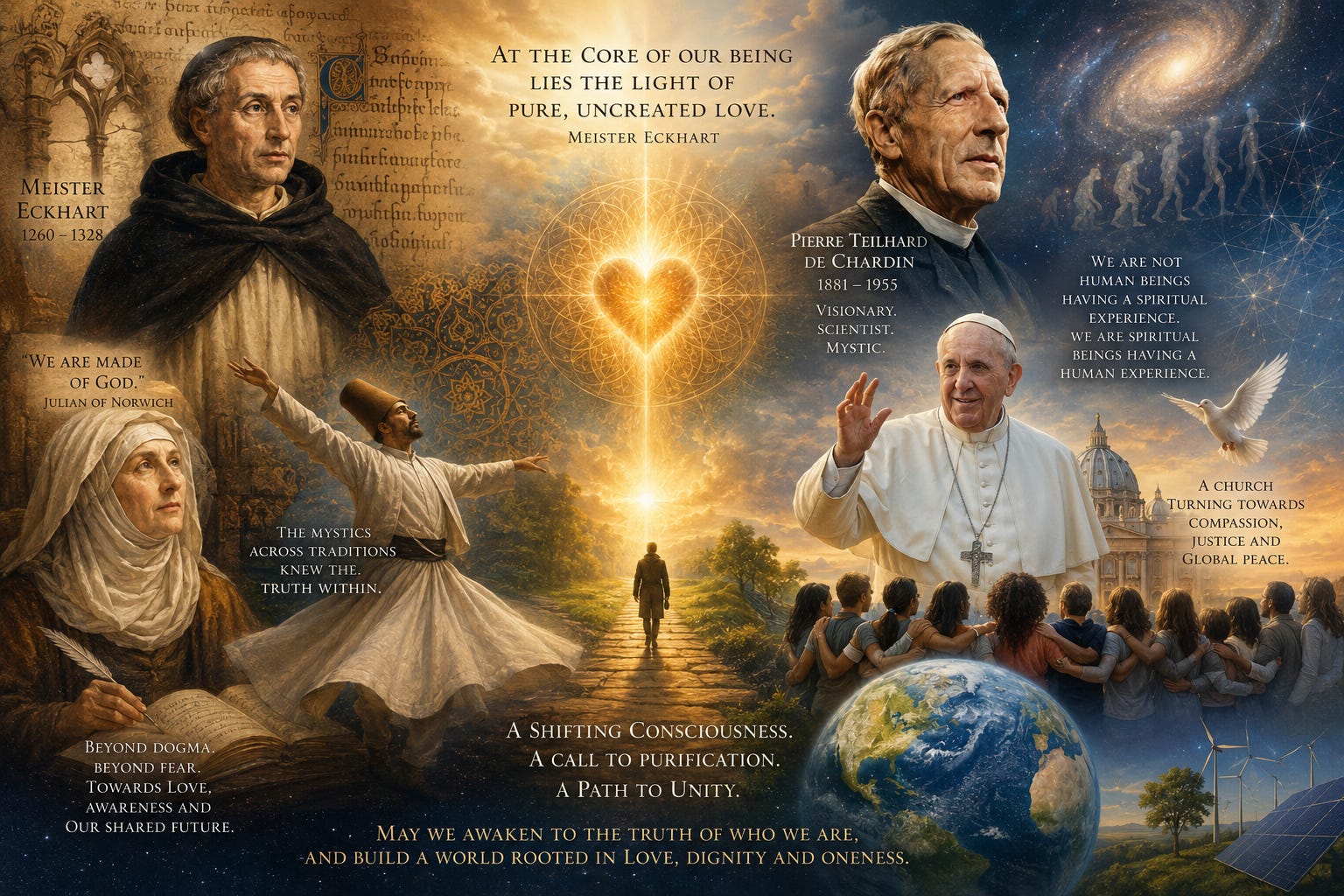
I recently began reflecting on the wisdom of the medieval mystic Meister Eckhart, a Dominican friar who engaged profoundly with the interior spiritual life in the manner of an illuminated master. His mysticism touched into my heart.
I believe that he, along with other mystics, discovered a profound truth concerning our deepest spiritual nature, even from within the rigid structures of the medieval Catholic Church. Eckhart realised his essential identity as a divine spiritual being beyond form. Some of the technologies helping this shift for Eckhart were possibly a combination of deeper and greater methods of learning; the development of forms of prayer that created the ground space for contemplation to arise, and likely, for Eckhart and others, some predisposing factors in human nature itself.
As a Dominican friar of his time, he was obliged to frame his insights carefully within the language of scholastic theology in order to avoid unwanted attention from powerful and potentially dangerous ecclesiastical authorities.
Perhaps the most subtle and profound revelation he shared was that, at the core of our being, lies the light of pure, uncreated love. What I hear in this insight is that our true identity is so much more than a creation ultimately separate in substance from its Source. It suggests that we are more than souls created in the image of God. As Julian of Norwich expressed it, “We are made of God.”
To articulate such an insight in his time was extraordinary. Eckhart came remarkably close to asserting our inherent divinity. Inevitably, his mysticism aroused suspicion within the Church hierarchy. Towards the end of his life, his spiritual teachings came under intense ecclesiastical scrutiny and investigation. Eckhart passed into eternity before the process reached its conclusion.
Many medieval mystics experienced this divine knowing of our deepest spiritual nature, but I believe that Eckhart apprehended it with an unusual degree of conscious clarity, perhaps more explicitly than figures such as Teresa of Ávila. Julian of Norwich also seemed to sense this truth intuitively when she described our very substance as being “made of God”.
Islamic mystics were similarly compelled to navigate a precarious path. Historically, Sufis often faced oppression because of their mystical beliefs, and even today Sufi Muslims continue to experience persecution within certain regions.
In the early to mid twentieth century, Pierre Teilhard de Chardin emerged as a Jesuit priest, scientist and mystic. His extraordinary insights into the nature of consciousness, the spiritual evolution of humanity and the relationship between human awareness and the planetary system rendered him deeply controversial within the twentieth century Catholic Church. He suffered considerably as a consequence of the institution’s hostility towards his work, although today his contributions are widely recognised and increasingly honoured.
A shift in global consciousness?
At this current point in history, I believe we are witnessing a profound shift in global consciousness, one that is shaking and destabilising many of the established structures of our civilisation. I sense this is a shift Teilhard himself saw coming. Within this movement of consciousness religion itself is gradually being summoned into a period of purification; to become more conscious of its collective shadow and do the work of integration.
The Reformation of Religion
Religious systems need to cleanse their propensities towards patriarchal patterns of power and control. Patriarchal patterns of control are a toxicity that has made religion harmful to people, especially women and minorities.
My intuitive sense is that religions are being called to delve more deeply into the wellsprings of their own compassionate roots. I sense that they need to reevaluate everything in relationship to the Golden Rule, present in all religions. This is the direction into which conscious evolution, I believe, is inviting religion to go.
This evolutionary impulse is inviting the whole of human civilisation into this direction, but for now I will keep my focus on religion.
For me one of the clearest indicators of this call to consciousness was the emergence of the Charter For Compassion
The Charter for Compassion began in February 2008, when British author and scholar of comparative religion Karen Armstrong was awarded the prestigious TED Prize. As part of the award, she was granted a wish to help change the world, which she used to propose the creation of a global document founded on the principles of compassion, empathy, and the Golden Rule.
Rather than drafting the text independently, Armstrong invited people from around the world to contribute their ideas through an online platform. Tens of thousands of submissions were received from individuals representing a wide range of spiritual traditions, nationalities, and cultures. A dedicated council of spiritual leaders and thinkers later convened in Switzerland to review these contributions and shape the final wording of the Charter.
The completed document was officially unveiled in November 2009, marking the beginning of an international movement committed to embedding compassion into everyday civic, educational, and social life:
“We, the global community of Earth, stand at a threshold moment in human and planetary history. The principle of compassion, which has always resided at the heart of all religious, ethical, spiritual and indigenous traditions, now calls us to a profound transformation, from separation to kinship, from charity to justice, from competition to cooperation and from human-centred thinking to universal awareness. We recognize that authentic compassion begins with the understanding that inner healing extends outward through just relationships, regenerative systems, and reverent care for all life. Compassion is both a deep awareness of suffering and a courageous commitment to transformation, addressing symptoms and root causes through intentional action and structural change.
We are called to make compassion a clear, luminous and dynamic force in our world as it awakens to greater interconnection and wholeness. Rooted in inner healing and manifested as justice, this expanded compassion can dissolve our perceived boundaries between self and other, human and nature, past, present and future. Born of our deep interdependence with all life, compassion is essential to human relationships and to the continuation of life itself on Earth. It is the path to collective healing and indispensable to the creation of regenerative economies, restorative justice and a thriving planetary community. We call upon all beings to join this great work of our time: the transformation of our civilizations from systems of domination to cultures of partnership, from economies of extraction to economies of care, from a patterned consciousness of separation to an expanded awareness of sacred kinship with all life.
This Charter is our sacred promise to life itself, a commitment to embody the change we seek, to heal wounds we have inherited and to plant seeds of flourishing for generations yet to come. It is an invitation to participate in the greatest story ever told: the story of life awakening to its own sacred nature and choosing love over fear, cooperation over domination and healing over harm.
May our words become actions, our actions become culture and our culture become the foundation for a world where all beings can thrive in dignity, beauty, and beloved community.
The Charter speaks for itself.
Reactions against this flow of consciousness
The more extreme expressions of religious fundamentalism in recent times, and they have often been vociferous, can perhaps be understood as manifestations of unconscious resistance to this deeper movement of change. Jihadist militant groups such as ISIS, alongside strands of Christian fundamentalism in the United States that interpret conflict in the Middle East through an apocalyptic lens, may be seen as examples of this resistance. Fundamentalist expressions across all traditions will ultimately struggle to survive a broader movement towards greater global consciousness.
The Roman Catholic Church: The Shift Begins
As an institutional structure, distinct from the ordinary faithful, the Roman Catholic Church has undergone a painful process of humbling and deconstruction. Humbled before the world by the horrific revelations of abuse and cover ups across many countries, Catholicism has been compelled to confront aspects of its own shadow. This was not done willingly. The structures of patriarchal power initially tried to resist. This shadow work remains an ongoing process. Yet I also believe we are witnessing the beginnings of a transition into a new phase of consciousness that I never expected to see.
Following the election of Pope Francis in 2013, a significant shift became visible within Catholicism. The Church began to move away from some of the rigid conservatism associated with previous eras and started doing things that would once have seemed impossible. It increasingly adopted the language of welcome towards LGBTQ people, single parents in relationships outside marriage, unmarried couples and divorced and civilly remarried couples. This changing tone was accompanied by significant gestures of apology and reconciliation towards Indigenous peoples and others who had experienced suffering, exclusion or alienation through the actions of the Church.
Rome also began to shift away from an overwhelmingly narrow focus on sexual morality, birth control and rigid dogmatic positions, emerging instead as an increasingly prophetic voice against the horrors of war, economic injustice, intolerance and social exclusion. At the same time, it placed greater emphasis on the dignity of migrants, the urgency of climate action and the pursuit of global peace. Pope Francis was seen on Maundy Thursday washing the feet of prisoners and kissing their feet. He stripped himself of the privileges of the papacy, choosing to live in a single room in a simple bed and breakfast hotel (St Martha’s) in the Vatican grounds. He urged the clergy to simplify their lives and live in service to the faithful.
Under Francis, the institutional Church became increasingly critical of traditional assumptions surrounding the moral legitimacy of war and placed a much stronger emphasis on nonviolence, dialogue and peace. More recently, Pope Leo has spoken directly about political and economic injustice which were clearly directed towards a particular powerful world leader. He has challenged powerful technological interests of Silicon Valley’s billionaire elites, over the ethical dangers associated with the rapid and insufficiently regulated development of artificial intelligence. His encyclical Magnifica Humanitas.
Magnifica Humanitas encyclical issued by Pope Leo XIV in May 2026, focuses on safeguarding the inherent value and dignity of the human person during the rapid rise of artificial intelligence. The document asserts that human intelligence is uniquely spiritual and embodied, meaning algorithms cannot replace authentic human experience, moral conscience or the intrinsic worth of the individual. Leo did not condemn this new technology but established a moral framework urging global society to prioritise the common good, protect vulnerable workers, counter automated disinformation, and ensure that technological advancement serves humanity rather than reducing people to mere data points or economic tools.
The sheer extent of this institutional reorientation can seem almost unbelievable. Yet there is still much further to go. I believe that, with time, we will witness even greater shifts in response to the growing injustices and dangers facing humanity by the Catholic Church. This is a sign amongst signs that the world is in the midst of a global shift of consciousness.
This trajectory will, I believe, unfold across many forms of organised religion over the coming decades as humanity moves towards a more unified global consciousness. Rigidity, harsh religiosity, spiritual abuse, the desire for control, the manipulation of consciences and the use of fear based teaching will find increasingly little place in a world in which compassion is deepening and new psychospiritual technologies are emerging that may enhance and expand our collective awareness.
Beyond religious institutions this seismic movement of love focused consciousness will equally start to destabilise the malignant patterns of behaviour within systems of government, economics, corporate power, law and media institutions. This I believe will be an energising reorientation for all humanity away from grasping, war, exploitation, ecocide, injustice, inequality, separation and control. This shift in consciousness seeks to move us towards a direction of deeper recognition of our shared spiritual nature, our interconnectedness and the sacredness that resides at the heart of all being.
I hope we can make this transition without greater suffering and conflict arising from resistance. If we can allow this consciousness to act like a gentle melting warmth, slowly thawing out our resistance to love’s endeavours, we may make this transition without needless suffering. My optimism about this happening more gently, however is not great. Based on what we are witnessing right now, upheaval seems to be the modus operandi. Truth, as they say, is the daughter of time.
The shift begins with you and I. Maybe we might be the difference that makes a difference ♥️🌍