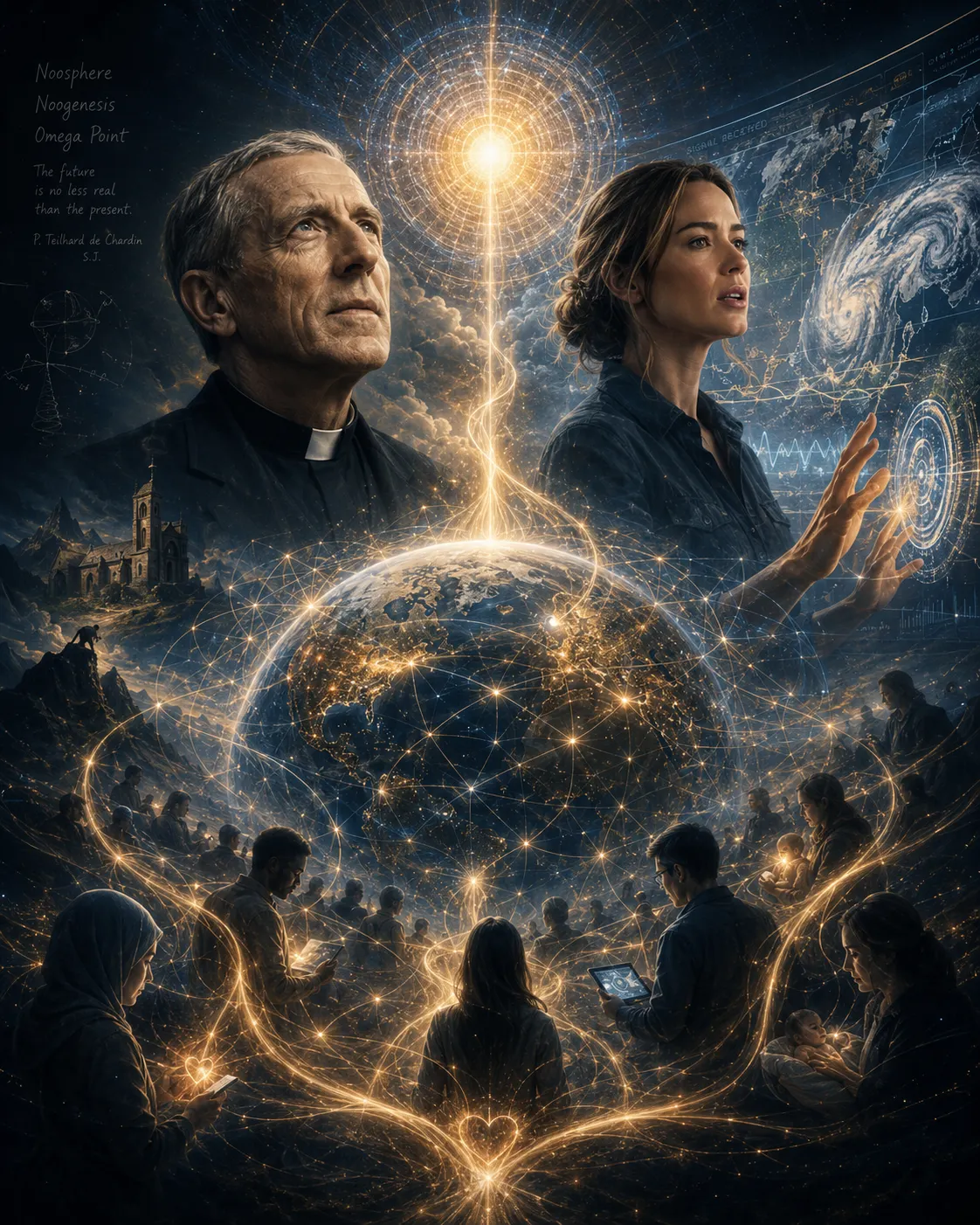
Teilhard de Chardin, Consciousness and the Cosmic Imagination of Disclosure Day
Pierre Teilhard de Chardin approached evolution not simply as a biological process, but as a spiritual and cosmic journey. For him, evolution did not end with the emergence of the human body. Instead, it moved from the physical development of life into the deeper evolution of human consciousness. To describe this next stage, the joining and intensification of minds, Teilhard developed a series of interconnected ideas that find a striking modern parallel in Steven Spielberg’s film Disclosure Day, particularly through Emily Blunt’s character, a weather forecaster who becomes uniquely capable of channelling alien discourse.
The Noosphere as the Thinking Layer of Earth
Teilhard described the Noosphere as the Earth’s thinking layer. Just as the planet has a geosphere made of rock and a biosphere made of living organisms, he argued that it is also developing a noosphere, a term derived from the Greek word for mind. This noosphere is a collective, planetary layer of human thought, knowledge and consciousness surrounding the globe.
As humanity spreads across the planet and becomes increasingly interconnected through communication, culture and shared understanding, individual minds begin to weave together into a unified network of consciousness. In Disclosure Day, Emily Blunt’s character embodies a literal breakthrough into this kind of collective reality. By channelling an external, non human discourse, she moves beyond the limits of isolated human intelligence and taps into a broader field of planetary and cosmic information. In doing so, she mirrors Teilhard’s vision of an interconnected global mind awakening to its place within a wider universe.
Convergence and the Evolution of Mind
Teilhard also developed the concepts of convergence and noogenesis. Earlier biological evolution largely operated through divergence, as species separated, adapted and diversified into different branches. Teilhard argued that the next phase of evolution works differently. It moves through convergence.
Because human beings share one closed, spherical planet and are intensely social, their thoughts, cultures and histories are increasingly pressed into contact with one another. Over time, they interlock, interact and move towards a higher collective complexity. Teilhard called this process noogenesis, the evolution of mind.
A similar pattern appears in Spielberg’s thriller, where characters are forced to abandon isolated institutional thinking when confronted with a larger cosmic truth. Their survival depends not on separation, rivalry or secrecy, but on a new form of global cooperation. The film therefore dramatises Teilhard’s belief that humanity’s next evolutionary step lies not in further fragmentation, but in a more conscious form of unity.
Personalisation and the Preservation of the Self
One of the central tensions in Teilhard’s thought is the relationship between collective consciousness and personal identity. A common fear of any collective mind is that the individual will be absorbed or erased, as in a hive mind or a totalitarian system. Teilhard firmly rejected this possibility. He argued that true union does not diminish the person. Rather, union differentiates.
For Teilhard, the individual becomes more fully themselves when joined to a higher order of meaning. A cell finds its purpose within the living body, and a musical note finds its significance within a symphony. In the same way, the human person is not destroyed by participation in the noosphere, but fulfilled through it. Teilhard called this process personalisation.
Blunt’s character follows a similar pattern. She does not lose her humanity when she becomes a bridge between human and non human intelligence. Instead, her distinctiveness is intensified. Her personal perspective becomes the very means through which a greater consciousness can be accessed. The film therefore suggests, like Teilhard, that contact with a larger collective reality need not dissolve the self. It can enlarge it.
Amorisation and the Energy of Love
Teilhard identified the force driving this evolutionary movement as amorisation, or the energy of love. He did not understand love merely as a private emotion or sentimental feeling. He saw it as a cosmic force of attraction, the deep energy that draws separate elements together into more complex and meaningful forms.
This force operates throughout evolution, from atoms forming molecules, to molecules forming cells, to cells forming living beings. In the next stage of evolution, love becomes the spiritual gravity that allows minds to converge without domination or erasure. It enables consciousness to unite in freedom, dignity and mutual recognition.
Within the imaginative world of Disclosure Day, this idea resonates strongly. The encounter with alien intelligence is not simply a matter of fear, threat or technological spectacle. It raises the deeper question of whether communication across difference is possible, and whether consciousness can expand without losing compassion. Teilhard’s answer would be that only love can make such convergence truly human.
The Omega Point and Cosmic Destiny
Teilhard’s vision ultimately points towards what he called the Omega Point. This is the final horizon of evolutionary convergence, the state of maximum complexity and complete consciousness in which the noosphere becomes fully unified. For Teilhard, this was not a vague impersonal force, but a supreme, personal and loving reality, fully realised in Christ, drawing the universe towards its spiritual completion.
Spielberg’s Disclosure Day raises a related theological and cosmic question. If intelligent life exists beyond Earth, then humanity must ask whether God is understood too narrowly when imagined only within an earthly frame. The film’s alien encounter therefore opens up a larger spiritual possibility, challenging human beings to rethink their place in creation.
In this sense, both Teilhard’s philosophy and the narrative arc of the film suggest that human consciousness is being drawn towards a grander destiny. Evolution is not merely a record of the past, but a movement towards a wider future in which mind, spirit and cosmos become increasingly intertwined.

Building the Earth
Teilhard captured this collective task when he wrote that the age of nations is past, and that the task before us now, if we would not perish, is to shake off our ancient prejudices and build the earth.
Conclusion
Taken together, Teilhard de Chardin’s evolutionary theology and the imaginative world of Disclosure Day suggest that humanity stands at the threshold of a profound transformation. Evolution is no longer presented simply as a biological struggle for survival, but as a movement towards deeper consciousness, greater unity and a more expansive understanding of creation. Through Emily Blunt’s character, the film gives dramatic form to Teilhard’s belief that the human mind is not isolated, but part of a wider field of meaning that may extend beyond the Earth itself.
Yet this movement towards unity does not require the loss of personal identity. On the contrary, both Teilhard’s thought and the film’s narrative imply that the individual becomes more fully themselves when drawn into a larger pattern of connection. The self is not erased by contact with the cosmic whole, but enlarged by it. In this way, Disclosure Day becomes more than a story of alien communication. It becomes a meditation on the future of consciousness, the spiritual destiny of humanity and the possibility that love may be the force capable of binding together minds, worlds and civilisations.
Ultimately, the parallel between Teilhard and Spielberg’s vision lies in their shared conviction that humanity must grow beyond fear, division and narrow earthly thinking. To build the earth is also to open the human imagination to the cosmos. If humanity is to survive and flourish, it must learn to converge without domination, to communicate without erasure and to recognise that the journey of evolution may be drawing all consciousness towards a greater unity still to come.
Bibliography
Blunt, Emily. Interview material on Disclosure Day and the alien voice performance. Business Insider, 2026.
Chardin, Pierre Teilhard de. The Phenomenon of Man. Translated by Bernard Wall, with an introduction by Julian Huxley. New York: Harper, 1959. Originally published as Le Phénomène humain, Paris: Éditions du Seuil, 1955.
Chardin, Pierre Teilhard de. The Future of Man. New York: Harper and Row, 1964.
Chardin, Pierre Teilhard de. The Divine Milieu. New York: Harper, 1960.
Chardin, Pierre Teilhard de. The Human Phenomenon. New edition and translation by Sarah Appleton Weber. Brighton and Portland: Sussex Academic Press, 1999.
Chardin, Pierre Teilhard de. The Formation of the Noosphere. Originally published in Revue des Questions Scientifiques, 1947. Later collected in The Future of Man.
Entertainment Weekly. Out of this World: Steven Spielberg Exposes the Truth About His Latest Extraterrestrial Thriller Disclosure Day. Entertainment Weekly, 2026.
Film Stories. Disclosure Day: Dissecting the New Trailer and Its Connections to UFO Lore. Film Stories, 2025.
Haught, John F. Pierre Teilhard de Chardin’s The Human Phenomenon. Theology, 2009.
Lahoz Beltra, Rafael. The Crisis of Noosphere as a Limiting Factor to Achieve the Point of Technological Singularity. arXiv, 2014.
Space.com. Disclosure Day Review: A Close Encounter with Spielberg’s Brilliance That Doesn’t Quite Make Contact. Space.com, 2026.
The Guardian. Alienated by Disclosure Day? You Are Not Alone. The Guardian, 2026.
Vidal, Clément. Pierre Teilhard de Chardin: A Visionary in Controversy. Evolution, Mind and Culture, 2021.