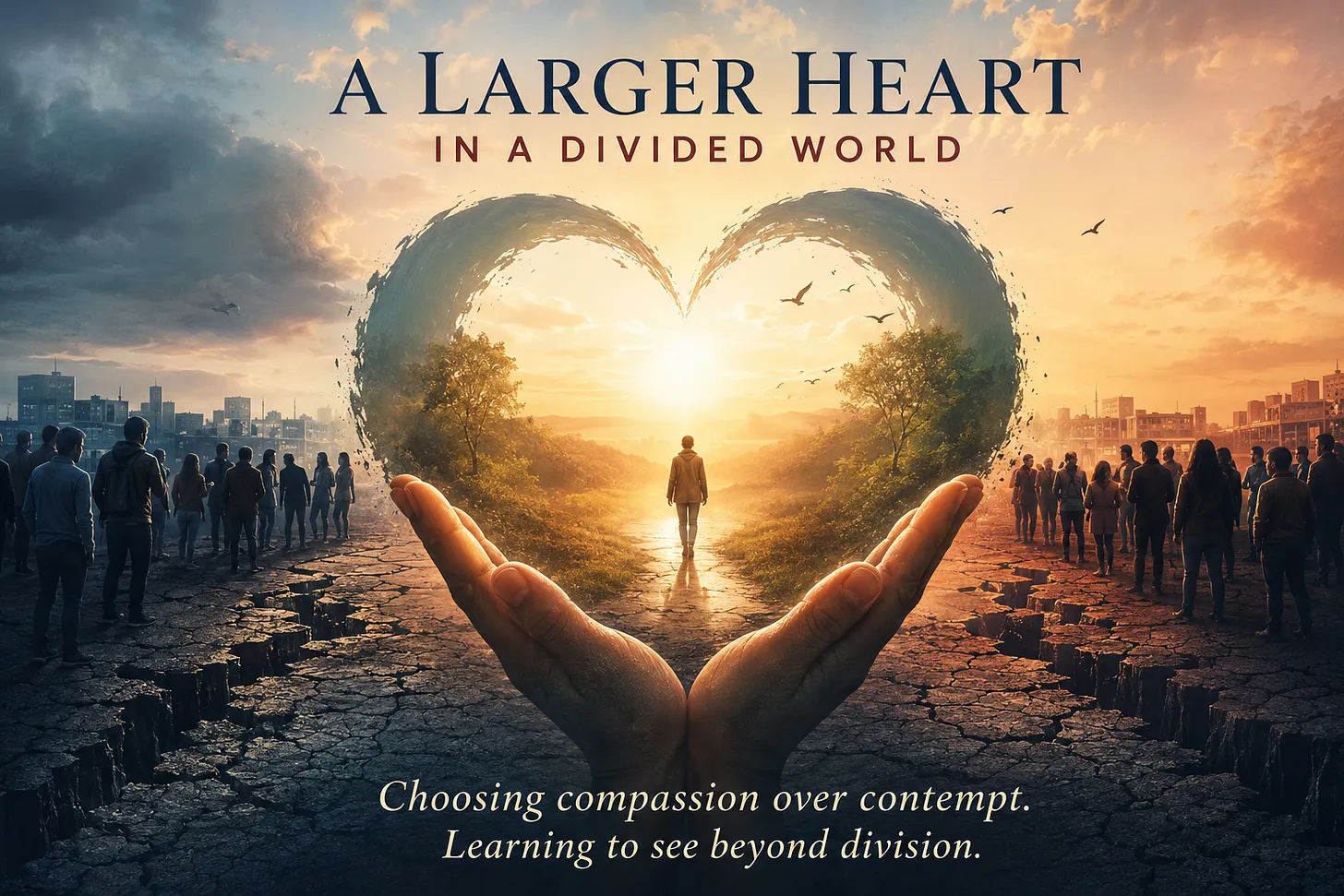
A Larger Heart in a Divided World
We are all witnesses to the deep divisions and polarisation tearing apart local and national communities, as well as the global community. Political movements, the media and its constant breaking news, dogmatic ideologies, avaricious corporatism, superficial social media and corrosive algorithms are among the toxic forces encouraging us to decide quickly who is right and who is wrong, who belongs and who should be pushed aside, who should be included and who should be cancelled. Even good and noble causes can become toxic under these influences.
Dietrich Bonhoeffer wrote that judging others makes us blind, while love helps us to see. His wisdom invites us into the difficult work of relinquishing hasty judgements, sitting with the discomfort of uncertainty and recognising that our individual human minds are incapable of knowing everything.
This does not mean excusing the horrific realities of murder, brutality, exploitation, corruption, discrimination, dishonesty and cruel indifference. Rather, it invites us into the humility of recognising that we will never truly be capable of judging any human being, no matter how heinous their crime, as unworthy or beyond redemption.
My Journey from Defensive Certainty to Compassionate Unknowing
I came out as a gay man at the age of twenty two while studying theology at a traditional Catholic college. I had been wounded by the radically conservative Catholicism of Pope John Paul II and by the teaching of the then Prefect of the Congregation for the Doctrine of the Faith, Cardinal Joseph Ratzinger, who later became Pope Benedict XVI.
The description of my ontological being as intrinsically disordered stung deeply. Even today, hearing that term evokes in me a sense of almost incredulous disbelief. This teaching left me feeling that something central to who I was could not be welcomed or blessed.
I also grew up in a loving but highly dysfunctional family. My parents were good people, but they were deeply wounded by their own traumas.
My father was a child during the Second World War. His family lived in poverty and destitution. He saw the bloodied bodies of people whose homes had taken direct hits during the Blitz.
My mother grew up in rural Ireland, a country that had been brutalised by British colonisation. Her family was poor. Her mother was fanatically religious because of her own traumas and insecurities.
My parents struggled with parenting because the wounded younger parts of themselves had never been given the opportunity to heal. People can love us deeply and still pass on pain they have never had the opportunity to understand and integrate.
As an adult, I never wanted to become a parent. I think that, at some unconscious level, I did not want to pass on generational wounds.
When I came out of the proverbial closet, I was an insecure and defensive young man. I became polarised in my thinking and intolerant of people whose beliefs and values differed from my own. Sometimes I was standing up for something important. At other times, I was protecting a frightened and wounded part of myself.
Thankfully, over the years, something began to soften within me.
Four people entered my life when I was twenty four, twenty six, twenty seven and thirty nine. Two of them remain a daily and profound part of my existence, while I am still in periodic contact with the other two. Somehow, through our kindness, sensitivity, good hearts and shared wounds, for we had all suffered, we became unwitting teachers to one another.
I am grateful to them all. Grace sometimes comes to us in unexpected ways.
The deaths of my parents, my father shortly before Christmas in 2005 and my mother in January 2007, set me upon a journey of grief that changed my spiritual worldview for ever.
The Experience of Palliative Care

Working in palliative care also changed me profoundly. Sitting with people approaching death, and with those experiencing grief, melted many of my dualities and certainties. Love, fear, regret, grief, tenderness and the need not to be alone can powerfully remind us that life is fragile and that opinions come and go like the wind.
The Alchemy of Change

I have come to understand that this slow transformation is continuing to shape my perceptions and reconfigure my inner world. I hope it will continue until I take my final breath.
It requires a commitment to healing our hubris and allowing our certainties to be destabilised. As the wisdom of A Course in Miracles suggests, “I do not understand anything I see.”
There is a divine spark at the heart of every person. This spark is the presence of boundless love, which some spiritual traditions call divine grace.
Miranda Macpherson, a spiritual teacher who embodies the energy of the divine feminine in the world, speaks of grace as an alchemical divine presence within us. Its influence does not depend upon our holding religious or spiritual beliefs. It works through our openness to relationship and love.
Sadly, in some people, this inner love is so obstructed that it cannot undertake its alchemical work through human relationships, self reflection and life experience. Such people may leave a trail of destruction behind them.
I am profoundly grateful that love’s endeavour has mellowed my binary thinking, softened some of my hard edges and created a reservoir of compassion within me. That compassion at least wants to try to include everyone in my heart, even those whose values are diametrically opposed to my own.
The Temptation to Scapegoat
René Girard believed that human beings imitate one another far more than we realise. We imitate not only one another’s desires, but also anger, fear and blame.
When anxiety spreads through a group, people reflect and amplify it. Eventually, that anxiety may be placed upon a person or community who becomes the proverbial scapegoat.
Blaming the scapegoat can give us a temporary sense of unity. We know who we are because we know whom we oppose.
We see this in parts of the political right when migrants, refugees, poor people and minority communities are blamed for complex social and economic problems. Those with relatively little power are presented as the cause of insecurity, while the wider structures creating poverty and discontent receive far less attention.
We can also see it in parts of the political left. A desire for justice can become mixed with self righteousness, public humiliation and the wish to exclude anyone who uses the wrong language or holds an unacceptable opinion. A person may be reduced to a single mistake or belief, with little room for context, learning or redemption.
I experienced this personally following the death of Ann Widdecombe. I disagreed strongly with many of her beliefs and political positions. Yet I was deeply distressed by the lack of compassion expressed in some of the responses to her death.
Whatever our political differences, a human life had ended tragically. People who loved her were grieving.
I found some of the reactions so painful that I wrote to every Reform councillor in my constituency to offer my unconditional condolences. I did not need to agree with Ann Widdecombe in order to recognise her humanity or the suffering of those who mourned her.
For me, that small action became a way of refusing the demand that political difference must cancel compassion.
The political right and left do not always possess equal power, and their actions do not always have equal consequences. Power, law and social position matter. Yet the human temptation to create unity through contempt can arise anywhere.
Dorothy Day understood that it is easier to love humanity in the abstract than to love the particular person standing before us. Love becomes real when it reaches across the boundaries of sympathy, agreement and belonging.
When Algorithms Feed Division
Girard’s ideas have become especially relevant in the age of social media. Digital platforms do not simply show us what is happening. Their algorithms observe what holds our attention and then give us more of it.
Anger, fear and moral outrage keep us engaged. We pause, react, share and return. The system learns that division is profitable. It gradually surrounds us with increasingly extreme versions of our own views and increasingly disturbing images of those on the other side.
There is something deeply toxic about designing technology in this way. Our nervous systems become commercial resources. Our fear keeps us watching, while our anger generates income.
We also receive endless signals about what our group believes and whom it condemns. Before long, disagreement begins to feel like betrayal. We may begin to perform anger in order to prove that we belong.
Thich Nhat Hanh taught that what we repeatedly consume becomes part of us. This is as true of digital content as it is of food.
Every click can strengthen a habit of fear and judgement. Every pause before reacting can become a small act of freedom.
Compassionate Self Examination
Mindfulness helps us to notice what is happening within us before we are carried away by it. We learn to recognise anger as anger, fear as fear and shame as shame. The emotion may be understandable, but it does not always provide a complete account of reality.
Compassion focused therapy offers a similar insight. When we feel threatened or humiliated, the mind narrows. We become more likely to attack, withdraw or submit. We search for certainty and find complexity difficult to bear.
This has helped me to understand my earlier rigidity. My intolerance was not simply a collection of ideas. It was also the response of a nervous system that had learnt to expect judgement and rejection.
The answer was not to condemn myself. Brutal self criticism would only have added another layer of violence.
I needed to understand why my defences existed, accept responsibility for the ways in which they affected others and discover that I no longer needed to live entirely from them.
Compassionate self examination allows us to say, “This is present within me and it may cause harm, but it is not the whole of me.”
Lalla, the fourteenth century Kashmiri mystic, wrote of entering the jasmine garden of the soul. The image suggests that genuine spiritual understanding cannot remain second hand. We must enter our own interior world and discover what is living there.
We might ask what happens within us when another person disagrees with us. What old wound is touched? Why does difference feel threatening? Why do we sometimes need another person to be entirely wrong before we can feel secure?
Meister Eckhart taught that every creature is filled with God and can be read like a sacred book. To see another person in this way does not mean approving of everything they do. It means remembering that no human being is exhausted by our judgement of them.
Accountability without Vengeance
Compassion is not softness towards wrongdoing. It can tell the truth, protect vulnerable people and establish firm boundaries.
Compassionate accountability asks what happened, who was harmed, who bears responsibility and what must change. Scapegoating asks whom we can condemn so that the rest of us may feel innocent.
Accountability seeks truth, protection, repair and transformation. Vengeance seeks emotional satisfaction through another person’s suffering.
In William Paul Young’s novel The Shack, Mackenzie carries terrible grief and anger towards the man who murdered his daughter. Papa does not ask him to deny the evil of what happened or to abandon justice. Instead, Mackenzie is invited to release hatred as the organising centre of his life.
Forgiveness is not the same as excusing. It does not remove consequences or make unsafe relationships safe. It is the gradual release of the inner bond created by vengeance. It allows the wounded person to begin living beyond what was done to them.
Forgiveness should never be forced. Yet it preserves the hope that evil need not have the final word. The victim may find healing, and even someone who has committed terrible harm need not be declared permanently beyond redemption.
Rumi imagined a field beyond our rigid ideas of wrongdoing and rightdoing. He was not suggesting that right and wrong are meaningless. He was pointing towards a deeper meeting place where truth no longer requires hatred in order to remain true.
The Slow Work of Grace
Grace has often reached me through people and experiences I did not choose. It came through loving relationships, disappointment, loss and the privilege of accompanying people as they approached death. It came through discovering that those whose beliefs differed greatly from mine could still be generous, faithful and wise.
Grace has not made me indifferent to injustice. It has made me less willing to reduce anyone to an enemy.
Bonhoeffer’s life reminds us that love may require courageous resistance. Yet resistance does not have to become hatred. We can challenge wrongdoing while remaining aware that the capacity for fear, violence and self deception also lives within us.
As Thich Nhat Hanh taught, understanding gives rise to compassion. Understanding does not excuse harmful behaviour. It helps us to see the conditions from which that behaviour arose and gives us a better chance of changing them.
Towards a Larger Consciousness

Teilhard de Chardin imagined humanity growing towards a deeper form of shared consciousness. Today, we already possess something resembling a global nervous system. News, fear and outrage travel around the world within seconds. Yet our compassion has not developed at the same speed.
Our task is not to erase differences. It is to hold those differences within a wider sense of belonging.
I long for a world in which poor people are not blamed for poverty, migrants are not made to carry a nation’s fears and minorities are not treated as threats.
I also long for a world in which people are not publicly destroyed for making mistakes, moral language is not used to humiliate and disagreement does not end our recognition of one another.
I long for a political life that is passionate about justice but no longer addicted to enemies.
I long for communities in which people can admit that they have caused harm without being told that redemption is impossible.
I long for communities in which forgiveness does not remove accountability, but releases it from revenge. Communities in which victims are heard and protected, while those who have done wrong are still invited towards truth and metanoia.
The transformation we need is both inward and outward. We need fairer institutions, responsible leadership and technology designed around human wellbeing rather than endless engagement. We also need to examine the fear, shame and desire for superiority within our own hearts.
I believe that divine grace is always drawing us beyond identities shaped by fear. It is drawing us towards a consciousness permeated by boundless love, compassion and forgiveness.
Within that larger consciousness, our binaries begin to soften. Difference remains, but it no longer has to become division. Accountability remains, but it no longer has to become vengeance. Conviction remains, but it no longer requires contempt.
Perhaps this is the evolution Teilhard hoped for. Not a world in which everyone thinks alike, but a world learning to recognise itself as one living body.
A world in which the suffering of another is never simply someone else’s problem.
A world in which love becomes spacious enough to hold truth, justice, grief and forgiveness together.
I long for a world in which no one has to be cast out so that the rest of us can feel whole. A world in which our wounds are met with compassion rather than passed on. A world in which people are more than their worst choices and communities are more than their inherited fears.
A world in which grace continues to soften our hard edges and enlarge our hearts.
Perhaps that larger heart, repeated across millions of lives, is how the consciousness of the world begins to change.