Deliver Us From Evil: How Collective Rage May Become The Substance Non-Human Evil Feeds Upon.
This article is likely one of the most emotionally challenging I have written. It is based upon phenomena I am witnessing in the world which I believe is moving dangerously closer to its own destruction. I am witnessing it especially through the algorithmic patterns of media and social media.
Introduction
There are moments when human cruelty appears to exceed ordinary explanation.
We encounter a story of violence, abuse, murder, genocide or calculated harm against the vulnerable, and something within us asks: how could a human being do this? The question is not simply emotional. It is philosophical, psychological and spiritual. It recognises an excess. It senses that certain forms of cruelty do not merely appear immoral, but strangely inhuman. They seem cold, invasive, parasitic and hostile to life itself.
This essay explores the possibility that extreme evil cannot always be understood through psychology, sociology or moral failure alone. Across religious, spiritual, psychological and philosophical traditions, there is a striking convergence around one disturbing idea: evil may be parasitic. It does not create life, goodness, compassion or joy. It feeds upon what already exists and corrupts it. It enters through fracture, feeds upon suffering, spreads through deception and multiplies itself through collective rage.
I should say clearly at the outset that the claim that supernatural forces can influence human affairs reflects my own belief. This article does not require the reader to agree with that belief. It asks only that the possibility be considered. For some readers, this may function as a spiritual hypothesis. For others, the same patterns may be understood psychologically, phenomenologically, socially, symbolically or culturally. The central question remains important either way: what happens to human beings, and to human communities, when evil is not only committed, but also absorbed, repeated and unconsciously transmitted?
Human responsibility remains central. To ask whether something more than ordinary human pathology may operate at the furthest reaches of malice is not to excuse those who commit evil acts. Those who harm the vulnerable must be held accountable. Dangerous people must be restrained. Truth must be spoken. Justice must be pursued. Yet many traditions suggest that evil requires an opening. It enters through some fracture in the human person: narcissism, addiction, envy, despair, hatred, resentment, shame, cruelty, moral evasion or the refusal to face truth.
It is also necessary to make an important distinction. Not every person who suffers possession, infestation, oppression or manipulation within spiritual traditions is understood to be morally surrendered or susceptible to supernatural evil. Most are vulnerable because of trauma, grief, psychic sensitivity, spiritual openness, severe distress or even because they carry an important spiritual destiny that makes them the object of hostile attention. They require compassion, protection and restoration.
This article is primarily concerned with a different category: those who appear to come under malignant influence because of pre-existing narcissism, psychopathy, cruelty, moral evasion or a long refusal to listen to conscience. It is this latter category, and the effect of their crimes upon the collective consciousness of humanity, that forms the central concern here.
Dr M Scott Peck and the Refusal of Truth
The work of Dr M Scott Peck speaks deeply into this dilemma. Peck was a psychiatrist, psychotherapist and author whose work explored psychotherapy, human development, moral failure and spiritual growth. He did not begin as a sensationalist or as a writer preoccupied with supernatural evil. He began within ordinary clinical frameworks. Yet his encounters with human malice led him to conclude that some forms of evil could not be reduced to neurosis, social dysfunction or conventional psychopathology.
In People of the Lie, The Hope for Healing Human Evil, Peck described evil as a moral and psychological pathology rooted in the refusal to tolerate self-reproach. For Peck, the evil person is not merely someone who does harm. Evil is found in a sustained commitment to falsehood, in the sacrifice of others to preserve a fragile self-image, and in the refusal of truth when truth threatens the ego.
This matters because Peck does not locate evil first in dramatic supernatural phenomena. He locates it in the ordinary human decision to lie. Evil begins with the lie one tells about oneself. It begins when the person refuses to bear the pain of moral reality. Over time, this refusal creates a spiritual vacancy. The personality becomes organised around evasion rather than truth. For Peck, this could become more than psychological distortion. He came to believe that the sustained surrender of the will to falsehood could create a vulnerability to literal demonic influence.
One of Peck’s most haunting case examples is that of Bobby and his parents. Bobby was a depressed adolescent whose older brother had died by suicide. Peck noticed something deeply cold and emotionally detached in Bobby’s parents. In a session with Bobby, he discovered that the parents had given Bobby, as a Christmas present, the very twenty-two calibre rifle with which his older brother had killed himself. When Peck assumed it was merely the same kind of gun, Bobby corrected him with the devastating statement: “It was the gun.”
For Peck, this moment revealed the subtlety of evil. It was not theatrical. It did not announce itself with dramatic violence. It appeared through a gift, a family ritual, a plausible explanation and an almost total absence of moral awareness. Peck later confronted the parents. They defended the gift and appeared unable or unwilling to receive the moral meaning of what they had done. The horror of the case lies in its coldness. Evil here was not a sudden outburst of rage. It was concealed beneath normality, respectability and self-justification.
This is one of Peck’s most unsettling insights: evil often hides not in chaos, but in a polished refusal to know itself.
The Parasitic Nature of Evil
Religious and spiritual traditions have long attempted to describe the unseen dimensions of this reality. When they speak of demons, spirits, archons, parasites or forces of darkness, they are not merely offering primitive explanations for human behaviour. They are trying to name patterns of invasion, corruption and bondage that appear again and again in human experience.
Within the Abrahamic traditions, demonic beings are often understood as personal, noncorporeal intelligences whose hatred is directed against God, life, innocence and the human soul. Their power is parasitic rather than creative. They do not generate life. They distort, corrupt and feed upon what already exists. This is why the language of temptation, oppression, obsession, infestation and possession has persisted across centuries. Evil is understood not simply as the absence of good, but as an invasive hostility that attaches itself to disorder, trauma, sin, despair and spiritual blindness.
Similar patterns appear in shamanic and transpersonal traditions. These traditions may not use the language of demons, but they often describe intrusive forces, hostile spirits or energetic parasites that feed upon fear, grief, rage and suffering. From a shamanic perspective, such entities are opportunistic. They move towards weakness and fragmentation. They exploit trauma, addiction, terror, resentment, despair and psychic disintegration. The shamanic response is therefore not merely punishment or explanation, but extraction, cleansing, protection and the restoration of spiritual integrity.
Gnostic traditions offer another powerful parallel through the figure of the archons. In many Gnostic systems, the human being contains a divine spark but lives under conditions of forgetfulness, deception and captivity. The archons are lower ruling powers associated with ignorance, bondage and the false ordering of the world. Their aim is not merely to harm the body, but to imprison perception. They bind consciousness to appetite, fear, domination, illusion and spiritual amnesia. Evil, in this view, does not simply attack human beings from outside. It distorts the field of perception so that people no longer recognise their own divine origin or spiritual destiny.
Carl Jung and the shadow
Carl Jung provides another bridge between the clinical and the metaphysical. His account of the shadow and autonomous complexes suggests that the psyche contains forces that can behave as if they possess a will of their own. When rejected, denied or split off from consciousness, these contents do not disappear. They return with greater force. They may seize the personality, distort perception and produce behaviour that the conscious ego neither understands nor controls.
Jung does not need to be read as a literal demonologist in order to be useful here. His work shows that the human person is not transparent to itself. There are depths within the psyche that can become autonomous, destructive and overwhelming when they are not integrated through truth.
Jung believed that making the shadow conscious was essential not only for individual healing, but for the future of humanity. The shadow contains the rejected, denied and morally uncomfortable aspects of the self. When these elements are not consciously recognised, they are projected onto others. Projection becomes one of the deepest psychological roots of collective violence. Human beings come to see evil only out there, while remaining blind to their own capacity for cruelty, hatred and deception.
This insight is of immense importance in the present age. Modern humanity has gained extraordinary technological power without an equivalent growth in self-knowledge. We can spread rage instantly, shame people publicly, create mass moral panics, dehumanise entire groups and consume the suffering of strangers as entertainment. A civilisation that refuses its shadow will inevitably meet it outside itself, in enemies, wars, ideological possession and mass destruction. Shadow integration is therefore not a private luxury. It is a spiritual and ethical necessity.
Paul Levy and Wetiko
Paul Levy’s theory of wetiko speaks powerfully into this discussion. Levy describes wetiko as a contagious psychospiritual disease, a mind virus that operates through unconscious blind spots. It causes people to act against life while remaining unaware that they are possessed by the pattern. Drawing on Indigenous language, Jungian psychology, Buddhism and shamanic thought, Levy presents wetiko as a cannibalising force marked by greed, exploitation, separation, fear and the consumption of others, not only materially but psychically and spiritually.
Its power lies in concealment. It influences perception from within, so that the infected person or culture mistakes its own madness for normality.
Wetiko correlates strongly with Peck’s account of evil as self-deception and refusal of truth. It also resonates with Jung’s shadow and the shamanic view of parasitic intrusion. Evil does not merely act through isolated perpetrators. It spreads through communities by means of hatred, fear, projection and dehumanisation. In this sense, Levy gives the hypothesis a powerful transpersonal vocabulary. Evil is not only something one commits. It is something one can unconsciously host, transmit and amplify.
The Media as a Ritual Site of Projection
This becomes especially visible in the contemporary media environment. Every day, people are exposed to stories of cruelty, corruption, violence, predatory offending, murder, political betrayal, war, conspiracy theories, misinformation, social unrest and institutional failure. Some stories reveal genuine evil. Some expose real danger. Some concern people who must be restrained for the protection of the vulnerable. Yet other stories turn vulnerable groups, such as migrants, refugees or the poor, into containers for national anxiety and social disgust.
The categories differ, but the mechanism of projection remains similar. The public is repeatedly invited to locate evil entirely outside itself, in the criminal, the foreigner, the political enemy, the violent and predatory offender, the murderer, the corrupt official, the ideological opponent or the hated group.
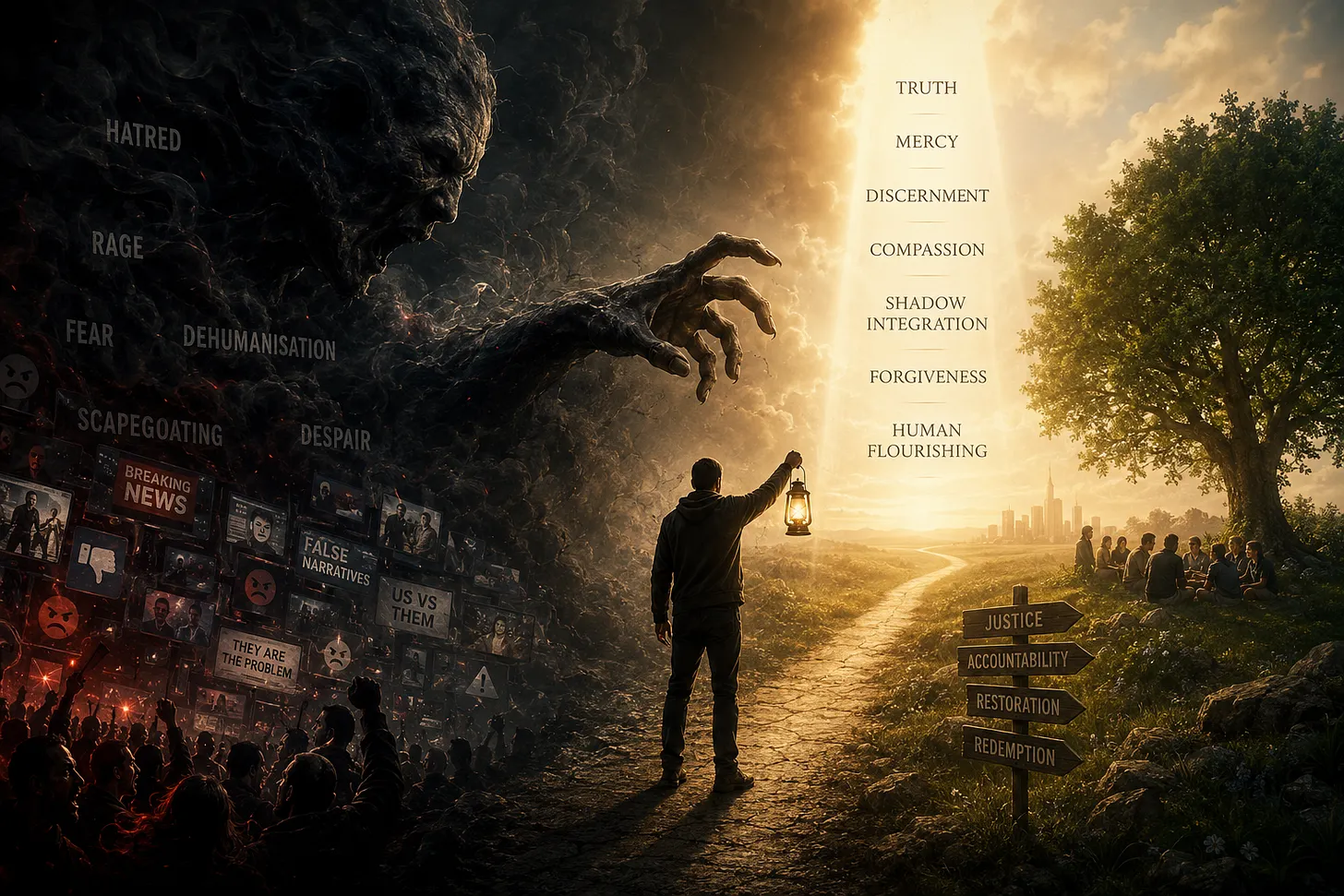
The spiritual danger is that the media environment can turn all of them into substances for emotional consumption. They become screens for collective projection. They become icons of fear, resentment or rage. They become the raw material through which malignant forces, whether understood spiritually or psychologically, feed on human reaction.
In such cases, the toxic substance is not the person or group being discussed. The toxic substance is the hatred generated around them. It is the loss of discernment. It is the collapse of compassion. It is the pleasure taken in contempt. It is the movement from justice into bloodlust, from moral clarity into dehumanisation, from legitimate concern into collective intoxication.
News stories and social media posts become ritual sites of emotional feeding. The victim’s suffering produces horror. The perpetrator’s wickedness produces rage. The migrant’s vulnerability produces fear or resentment. The politician’s corruption produces disgust. The violent and predatory offender’s crime produces revulsion. Each emotion may begin as understandable. But once amplified, repeated and stripped of mercy, it becomes material for something darker.
Vicarious Trauma and Collective Rage
Vicarious trauma is central to this process. It is the emotional and psychological impact of being exposed to another person’s trauma, especially through hearing, witnessing or repeatedly engaging with traumatic material. It can cause distress, anger, intrusive images, anxiety, depression, despair and a changed view of humanity.
In a media saturated society, vicarious trauma no longer affects only therapists, first responders or those directly involved in care. It affects whole communities. Millions of people repeatedly witness the suffering of strangers through screens. They absorb horror without context, responsibility, ritual, support or spiritual processing.
The first response to atrocity is often compassion, grief and moral outrage. These are human and necessary. They show that conscience is alive. Yet when these emotions are continually stimulated and algorithmically amplified, they can mutate. Grief becomes rage. Rage becomes contempt. Contempt becomes dehumanisation. Dehumanisation becomes the desire to annihilate. Online crowds intensify emotion. Public punishment becomes spectacle. Moral outrage becomes addictive. The boundary between justice and bloodlust becomes dangerously thin.
Within a metaphysical framework, this secondary wave of hatred may be understood as part of the strategy of noncorporeal evil. If such forces feed on terror, rage, despair and suffering, then the crime itself is only the beginning. The act against the innocent produces an initial harvest of trauma. The public reaction multiplies the effect. Through repeated exposure, media amplification and collective fury, the suffering spreads far beyond the original victim. The community becomes emotionally colonised by the event. People who would never commit the crime themselves begin to host hatred within their imagination. In this sense, horror becomes contagion.
Why Shame Makes Projection So Dangerous
This is especially dangerous for people burdened by their own past failures, shame or sense of unforgivability. A person who secretly feels condemned may find temporary relief in condemning someone else. If they feel stained by their own past, they may cling to the image of a worse sinner. If they feel that mercy is unavailable to them, they may withhold mercy from others. If they cannot face their own need for forgiveness, they may become obsessed with the unforgivability of another.
Projection then becomes both a psychological defence and a spiritual trap. The hated other carries the darkness that the wounded person cannot yet bear to recognise within themselves.
There are horrific acts of unspeakable evil in the world. Some people are so dangerous they may require lifelong restraint. Some public figures betray trust and must be held to account. But true judgement can become spiritually corrupted when it is infected with hatred, self-righteousness and the pleasure of dehumanisation. The person who feels secretly unforgivable may be particularly vulnerable to this corruption because the spectacle of another person’s disgrace offers a false form of purification. By hating the condemned person, the wounded spectator feels temporarily clean. Yet this cleanliness is an illusion. The projected shadow has not been healed. It has merely been displaced.
Justice is not Hatred
Across the traditions discussed, evil feeds upon life but cannot generate life. It cannot create joy, compassion, wisdom or love. It can only distort and consume. The victim’s pain becomes the first site of parasitic consumption. Terror, humiliation and suffering become psychic or spiritual nourishment. But the process does not end there. Once the suffering becomes public, the collective reaction becomes a second feeding ground.
Grief and outrage are natural responses to injustice, but when they harden into bloodlust, dehumanisation and consuming rage, the community begins to host the very destructive energy it condemns.
In this sense, evil multiplies itself by drawing both victim and witness into its economy of suffering. It wounds the innocent, then feeds again on the hatred generated in those who behold the wound. Its deepest strategy is reproductive: to turn pain into rage, rage into cruelty and cruelty into further darkness.
This is why a mature account of evil must distinguish justice from hatred. Justice seeks the restoration of moral order. Hatred seeks annihilation. Justice requires truth, proportion, discernment and protection of the vulnerable. Hatred feeds on simplification, spectacle and emotional intoxication. A community that cannot punish without becoming cruel has not defeated evil. It has merely allowed evil to change form.
This is also where restorative justice, rightly understood, becomes spiritually significant. Restorative justice does not deny evil, minimise harm or place unfair burdens upon victims. It does not mean that dangerous people should be released or that accountability should be softened. Rather, at its deepest level, restorative justice seeks the restoration of truth, responsibility and moral order. It asks whether even the person who has done evil might still be summoned, however painfully, towards redemption.
This is not sentimental. It is one of the most demanding forms of justice because it refuses both denial and annihilation. It insists that the victim’s dignity must be restored, the community’s moral wound must be acknowledged, and the perpetrator must be confronted with the full reality of what they have done. Where hatred seeks only to destroy the evil person, restorative justice asks whether the human being beneath the evil can still be called back into truth.
How Evil Appears to Consciousness
Phenomenology adds a further layer by asking how evil shows itself before it is explained away. It does not begin by deciding whether the experience is supernatural, psychological or cultural. Instead, it attends to the appearance of the phenomenon itself. How does extreme evil present itself to consciousness? How is it encountered by victims, witnesses, practitioners, exorcists, clinicians and communities?
From this perspective, the language of invasion, darkness, infection, contagion and possession cannot be dismissed too quickly. Such language may disclose something essential about the way profound evil is experienced. It appears not merely as wrongdoing, but as excess. It feels alien. It overwhelms ordinary categories. It seems to enter the room, thicken the atmosphere, distort the face, change the voice and bend the will.
A secular reading can still recognise the same structure. Trauma spreads through communities. Rage is contagious. Algorithms intensify emotion. Public punishment can become spectacle. Moral outrage can become addictive. The perpetrator dehumanises the victim, and then the public dehumanises the perpetrator. The cycle continues, each side convinced of its own necessity. What began as a crime against innocence becomes a broader corruption of perception, language and moral imagination.
The Task Before Us
The contemporary media environment can divert humanity from the very qualities needed for spiritual evolution: compassion, mercy, discernment, humility, patience, truthfulness and the capacity to hold moral complexity. A world in which evil cannot easily thrive would not be a world without justice. It would be a world in which justice is no longer contaminated by hatred. It would be a world in which the vulnerable are protected, offenders are restrained, lies are exposed and truth is spoken, but without the surrender of the soul to cruelty.
Such a world would require human beings who can face evil without becoming possessed by it.
This task is difficult because hatred often disguises itself as virtue. It tells us that our rage proves our goodness. It tells us that dehumanising the guilty protects the innocent. It tells us that contempt is courage and mercy is weakness. It tells us that compassion for any despised person is betrayal. In this way, malignant supernatural energies, or the psychospiritual patterns that resemble them, can use even genuine moral concern as fuel. They do not need people to approve of evil. They only need people to imitate its spiritual texture while believing they are opposing it.
The central warning is therefore not only that terrible people may do terrible things. It is that evil seeks participation. It seeks the perpetrator, but also the spectator. It seeks the wounded individual, but also the enraged crowd. It seeks the lie within the criminal, but also the hatred within those who condemn him. It seeks the shame of those who believe themselves unforgivable and offers them a false escape through projection.
Its deepest strategy is the degradation of consciousness itself. By transforming the suffering of the innocent into a catalyst for mass fury, it strips away mercy, discernment and empathy. It teaches human beings to mistake hatred for justice and cruelty for moral clarity.
Conclusion
The purpose of this article is not to encourage fixation on demons, entities or unseen forces. Such fixation can itself become another distraction, another form of fear and another way of giving darkness too much imaginative power. The deeper purpose is to become conscious of the ways in which human beings may inadvertently cooperate with destructive patterns through spiritual blindness, projection, rage and despair.
Whether one names these patterns demonic, archontic, wetiko, parasitic, psychological or cultural, their fruits are visible. They diminish compassion. They feed hatred. They turn suffering into spectacle. They divide communities. They weaken mercy. They seduce human beings into believing that cruelty can be righteous.
The real danger is not only that evil exists outside us. It is that, in our blindness, we may feed it. We may feed it with our attention, our hatred, our projections, our despair, our fantasies of revenge and our refusal to see the humanity even of those who must be judged. We may feed it when we allow media outrage to replace prayer, reflection, discernment and moral responsibility. We may feed it when we surrender our peace to every horror placed before us. We may feed it when we allow the pain of victims to become fuel for our own intoxication with rage. We may feed it when we use the sins of others to avoid the unresolved wounds and failures within ourselves.
The task, then, is not to deny evil, soften evil or excuse evil. Evil must be named. The vulnerable must be protected. Perpetrators must be restrained. Truth must be spoken. Justice must be pursued. But evil must not be imitated.
If there is an agenda hostile to humanity and human flourishing, seeking to destroy our happiness, peace and evolution, then it advances most effectively when human beings become unconscious carriers of its emotional signature. It succeeds when we become less compassionate, less discerning, less merciful, less truthful and less capable of love.
To resist such an agenda is to become spiritually awake. It is to recognise the openings through which destruction enters. It is to attend to trauma, integrate the shadow, refuse projection, resist collective bloodlust and recover the difficult discipline of mercy. It is to build a world in which evil cannot easily thrive because fewer human beings are willing to host it.
Such a world will not be created through sentimentality or denial, but through sober truth joined to compassion. The deepest victory over evil is not only that wrongdoing is restrained. It is that, in beholding evil, we do not allow it to remake us in its image.