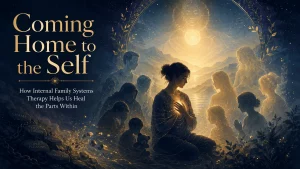
Many people come to therapy feeling divided inside. One part of them longs for change, while another part feels frightened of it. One part wants closeness, while another pushes people away. One part carries shame, while another works hard to keep everything looking strong and capable. This inner complexity is not a sign that something is wrong with us. It is a sign that we are human.
A Compassionate Way of Understanding Ourselves
Internal Family Systems Therapy offers a compassionate and hopeful way of understanding this inner world. Rather than seeing anxiety, anger, avoidance, people pleasing, self criticism, addiction, numbness or despair as enemies to be defeated, it asks a different question. What if these experiences are parts of us that have been trying to help, protect or survive in the only ways they knew how?
This is one of the great gifts of Internal Family Systems. It does not begin with judgement. It begins with curiosity. It does not ask, “What is wrong with me?” It gently asks, “What has happened inside me, and what are my parts trying to protect?”
The Self as the Centre of Healing
At the heart of Internal Family Systems is the idea of the Self. The Self is not another part of us. It is the deeper centre of awareness, compassion and wisdom within the person. Some people understand the Self psychologically, as the calm observing centre of the mind. Others experience it spiritually, as the soul, the divine spark, the image of God, or the place within us where love and wisdom are not destroyed by suffering. However it is understood, the Self is the inner capacity to meet ourselves with mercy.
In Internal Family Systems, healing happens when our parts are no longer left alone with their burdens. Instead, they are met by the Self with calmness, curiosity and compassion. Parts that have carried fear, shame, grief, rage or loneliness can begin to trust that they no longer have to hold everything by themselves.
The 8 Cs and 5 Ps of Self Energy
The qualities of Self energy are often described through the 8 Cs and the 5 Ps. These are not moral achievements or spiritual badges. They are signs that we are becoming less overwhelmed by our wounded or protective parts, and more able to relate to them from a deeper place of steadiness and care.
The 8 Cs
calmness
curiosity
compassion
confidence
courage
clarity
creativity and
connectedness.
These qualities are deeply healing because they change the inner atmosphere. A distressed part that has been met for years with fear, judgement or suppression may soften when it is finally approached with gentleness.
Calmness
Calmness helps the nervous system settle. When we are blended with a frightened or ashamed part, it can feel as though the whole of us is anxious, defective or unsafe. Calmness creates space. It allows us to pause, breathe and notice that something is happening inside us, rather than believing that the distress is the whole truth of who we are.
Curiosity
Curiosity opens the door to healing. Instead of attacking a part for being angry, controlling, avoidant or self critical, curiosity asks what that part is trying to do for us. Very often, the parts we dislike most are parts that have worked hardest to protect us from pain. They may use old strategies, but their deeper intention is often protective.
Compassion
Compassion is central. Many people are frightened that if they show compassion to a difficult part, they will be excusing harmful behaviour or giving up responsibility. Internal Family Systems understands compassion differently. Compassion is not indulgence. It is the clear and warm recognition that every part has a story. Even the parts that create problems usually began as attempts to help us survive something painful.
Confidence
Confidence grows when a person discovers that they can be with difficult feelings without being destroyed by them. The therapist helps the client notice that there is a deeper capacity within them that can listen, witness and lead. This can be profoundly empowering for people who have felt dominated by fear, shame or trauma.
Courage
Courage allows a person to turn gently towards what has been avoided. This does not mean forcing trauma material or pushing past protective parts. True courage in Internal Family Systems is patient and respectful. It means being willing to listen when a part is ready, and being willing to stop when a part says it is not yet safe.
Clarity
Clarity helps a person separate their identity from the state they are in. There is a great difference between saying, “I am hopeless,” and saying, “A part of me feels hopeless.” The first statement can feel like a prison. The second creates space. It allows the person to recognise that hopelessness is present, but it is not the whole of who they are.
Creativity
Creativity allows new possibilities to emerge. A part that has spent years managing life through control, withdrawal, perfectionism or emotional shutdown may discover that it no longer has to perform the same role in the same exhausting way. When parts feel heard and understood, the whole inner system can become more flexible.
Connectedness
Connectedness restores relationship. Trauma often fragments us. It can leave parts of us isolated, frozen in the past, or hidden away in shame. As parts are welcomed back into relationship with the Self, the person may begin to feel less divided inside. This inner connectedness can also make outer relationships feel safer and more authentic.
The 5 Ps of the Therapeutic Process
Alongside the 8 Cs, the 5 Ps describe other qualities that support the therapeutic process:
presence
patience
persistence
perspective and
playfulness.
Presence
Presence means being fully with what is showing up. Many people have spent years trying to get rid of their pain. Internal Family Systems invites a different posture. Rather than rejecting the part, we turn towards it and say, in effect, “I am here. I am listening. I want to understand.”
Patience
Patience is essential because protective parts often do not trust quickly. This is especially true for people who have experienced trauma, betrayal, neglect, spiritual abuse or repeated disappointment. A part that has protected the person for many years may not immediately believe that it is safe to step back. It needs time. It needs consistency. It needs to know that it will not be shamed or forced.
Persistence
Persistence means staying gently committed to the process. Healing often happens slowly and in layers. Some parts need to be visited many times before they feel safe enough to reveal what they are carrying. Persistence is not pressure. It is faithful inner companionship.
Perspective
Perspective helps the person see beyond one part’s story. When a distressed part is blended, it can feel as though its view is the only truth. A fearful part may say, “Nothing is safe.” An ashamed part may say, “I am bad.” A protective part may say, “Never trust anyone.” Perspective allows the person to honour the part’s experience while also recognising that there is a larger truth.
Playfulness
Playfulness may sound surprising in therapy, especially when people are dealing with trauma or grief, but it can be deeply healing. Playfulness brings lightness, imagination and flexibility. It reminds the inner system that life is not only survival. There can also be warmth, humour, movement and hope.
Meeting a Part Through the 6 Fs
In a therapy session, the Internal Family Systems therapist may help the client explore a part through what are often called the 6 Fs. These are:
find
focus
flesh out
feel toward
befriend and
fear.
This is not a mechanical technique. It is a compassionate way of making contact with the inner life.
Find
First, the client is helped to find the part. This might be a feeling in the chest, a tightness in the stomach, a thought, an image, an impulse, a memory or an inner voice. Parts often communicate through the body before they communicate through words.
Focus
Then the client is invited to focus on the part. This means gently bringing attention to it. Where is it felt? What is its energy like? Does it have an image, a shape, an age, a posture or a mood? The aim is not to analyse from a distance, but to begin a relationship.
Flesh Out
The therapist may then help the client flesh out the part. What does it want the client to notice? What emotions does it carry? What does it seem to believe? What role has it been playing in the person’s life? A self critical part, for example, may reveal that it has been trying to prevent rejection by making the person perfect. An avoidant part may reveal that it is trying to prevent overwhelm. An angry part may be guarding a much younger wound.
Feel Toward
The therapist then asks a crucial question. How do you feel towards this part? This question matters because it shows whether the person is relating from Self energy or whether another part has blended with them. If the client feels curious, compassionate or open, there may be enough Self energy to continue. If the client feels hatred, disgust, fear or impatience towards the part, that feeling is itself another part that needs attention.
Befriend
Befriending the part means building trust. The client may ask the part what its job is, what it is trying to protect, and what it wants the client to know. This can be very moving. Many people discover that the parts they have hated or feared were carrying loyalty, vigilance and pain.
Fear
Finally, the therapist gently explores the part’s fear. What is it afraid would happen if it stopped doing its job? This question often reveals the protective purpose of the part. A part may fear that the person would collapse, be abandoned, be harmed, be humiliated, lose control, or be overwhelmed by grief. Once this fear is understood, the part no longer has to be treated as an enemy. It can be honoured as a protector.
Understanding Burdens
Internal Family Systems also speaks of burdens. A burden is the pain, belief, emotion or energy that a part has been carrying. These burdens may come from trauma, family patterns, childhood wounds, shame, loss, rejection or fear. A young part may carry the burden of believing, “I am not lovable.” A protective part may carry the burden of believing, “I must control everything or we will not survive.”
Legacy Burdens and Inherited Pain
Some burdens are personal. Others are legacy burdens. Legacy burdens are the emotional and spiritual inheritances that pass through families, communities, cultures and histories. These may include shame, silence, fear, violence, religious terror, racial trauma, class humiliation, gendered expectations, exile, poverty, addiction or unresolved grief. Sometimes a person finds that they are not only carrying their own pain, but also the unspoken pain of those who came before them.
This is where Internal Family Systems can become deeply liberating. It helps a person recognise that not everything inside them began with them. Some burdens were inherited. Some were absorbed from the family atmosphere. Some were passed down through culture, religion or history. Naming this does not remove responsibility for our lives, but it does bring mercy. It allows us to say, “This pain is real, but it is not the whole of me. It may have come through me, but it does not have to continue through me.”
The Spiritual Dimension of Healing
The spiritual dimension of this work can be profound. Many spiritual traditions teach that beneath fear, shame and fragmentation there is a deeper wholeness. Christianity speaks of the image of God within the human person. Mystical traditions speak of the soul’s return to love. Buddhism speaks of compassion and awareness. Many wisdom paths recognise that the deepest healing is not achieved by hatred of the self, but by a loving encounter with what has been exiled.
Internal Family Systems offers a language that can sit gently alongside this spiritual wisdom. It suggests that there are no bad parts. There are wounded parts, protective parts, frightened parts and extreme parts, but beneath them all there is a deeper Self that can lead with love. For a spiritually minded person, this Self may feel like the place where grace can be received. It may feel like the inner sanctuary where God meets the person without condemnation. It may feel like the divine spark that has never been extinguished, even by trauma.
Healing the Whole Person
This does not mean that therapy becomes religious. It means that healing can honour the whole person. For some, the work remains psychological. For others, it becomes prayerful, contemplative or sacred. A part that has carried shame may need not only understanding, but mercy. A part that has carried fear may need not only reassurance, but blessing. A legacy burden may need not only insight, but release.
In this sense, Internal Family Systems can help people move from inner exile to inner reconciliation. It can help the person become a compassionate witness to their own story. It can help protective parts relax, wounded parts be heard, and burdened parts discover that the past does not have to remain alive in the same way inside the present.
Coming Home
The aim is not to become perfect. The aim is to become more whole. The aim is not to silence parts, but to listen to them. The aim is not to control the inner system through force, but to allow the Self to lead with calmness, courage, clarity and compassion.
Many people have been taught to treat their inner life as a battlefield. Internal Family Systems offers another image. The inner life can become a place of healing relationship. The parts of us that once seemed troublesome, shameful or frightening can be understood as carrying stories that need to be heard. When they are met by Self energy, they may begin to release the burdens they were never meant to carry forever.
This is the heart of the work. We do not heal by abandoning parts of ourselves. We heal by turning towards them with love, truth and patience. We heal by discovering that beneath the noise of fear and protection, there is a deeper centre within us that already knows how to welcome, witness and restore.
In spiritual language, this may be described as grace moving through the inner system. In psychological language, it may be described as integration. In ordinary human language, it may simply be called coming home.

