A Life of Peaceful Resistance
Dorothy Day’s approach to peaceful resistance was distinctive because it joined radical social activism, Christian anarchism and absolute pacifism. As co founder of the Catholic Worker Movement in 1933, she saw resistance not simply as protest or political strategy, but as a complete way of life. For Day, belief and action had to be inseparable.
The Foundations of Anti Nuclear Protest
Her principles directly shaped modern non violent protest and helped lay the foundations for the anti nuclear weapons movement. After the United States dropped atomic bombs on Hiroshima and Nagasaki in 1945, Day was among the few public religious figures to condemn the action immediately and unequivocally. She saw nuclear weapons as the ultimate expression of state violence, mechanised murder and the denial of human dignity.

Holy Disobedience
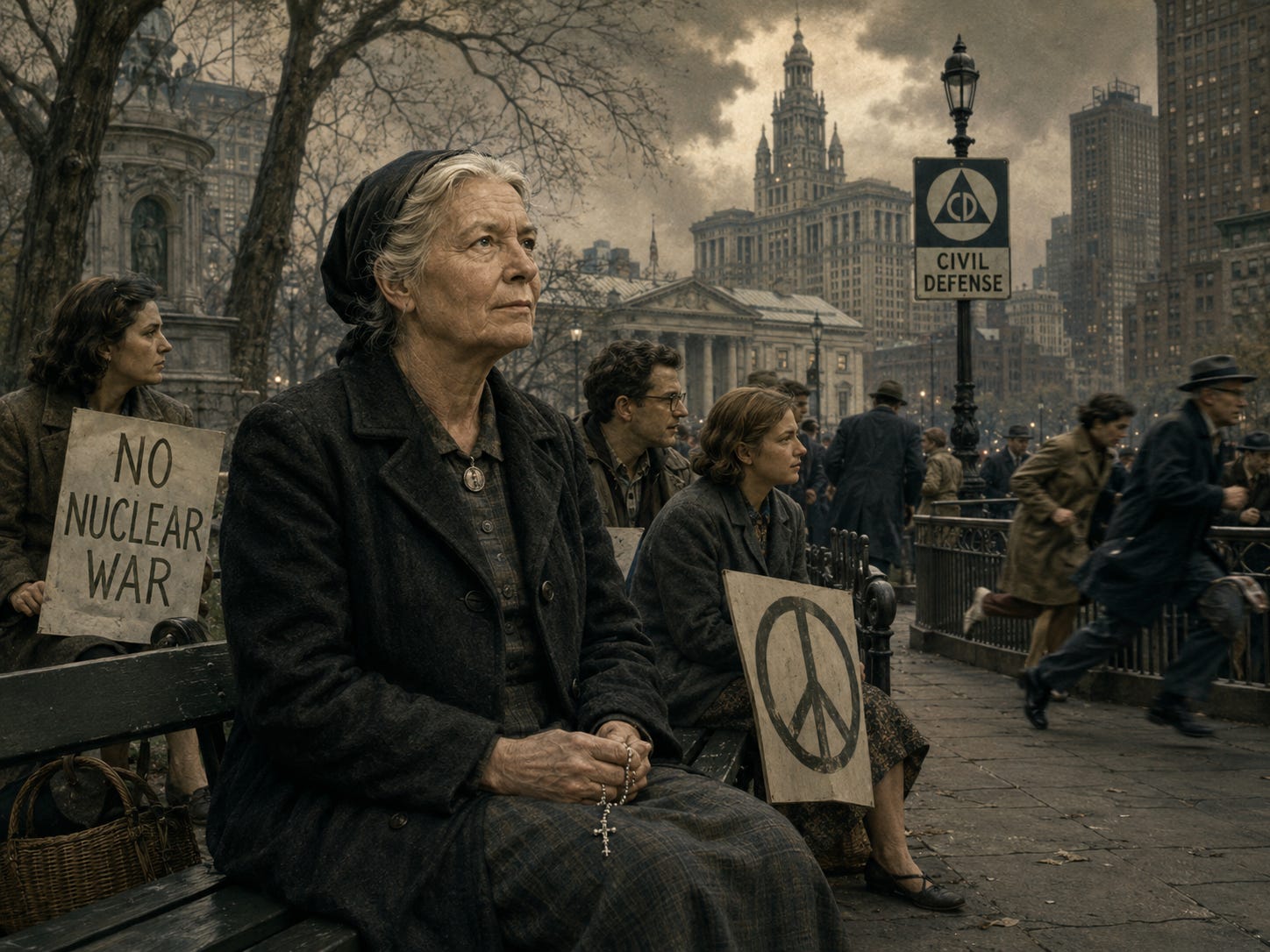
Day’s anti nuclear resistance was rooted in what she called holy disobedience. From 1955, New York State required citizens to take shelter during annual simulated nuclear attack drills. These drills were intended to train public obedience and suggest that nuclear war could be survived. Day rejected this logic. She argued that taking cover meant giving passive consent to the growth of nuclear arsenals and pretending there could be a defence against atomic war.
Refusing to Hide
In response, Day and a small group of pacifists refused to hide. They sat openly in City Hall Park while the sirens sounded. This quiet, visible act of non violent defiance forced the state to confront peaceful religious workers and elderly women with arrest and imprisonment. Day was jailed in 1955 and returned each year until 1961. Over time, the protest grew from a small group into a movement of students, mothers and ordinary citizens. By 1962, public non compliance had become so widespread that the compulsory drills were abandoned. Her actions showed that disciplined, repeated non violent resistance could weaken state enforcement.
Nuclear Weapons and Economic Injustice
Day also linked nuclear weapons to economic injustice. She argued that money spent on weapons of mass destruction was taken from the poor, meaning people were harmed before any bomb was dropped. Her witness later inspired Catholic and secular anti nuclear activists, including the Plowshares Movement of the 1980s, which used non violent direct action to disrupt military sites and symbolically damage nuclear equipment. Day showed that non violence was not passive. It required actively resisting the state’s preparation for mass death.
The Mystical Body of Christ
At the heart of her philosophy was the Christian belief in the Mystical Body of Christ. Day believed all people were spiritually connected, so harming another person, whether an enemy, opponent or marginalised individual, meant harming Christ and oneself. This made her pacifism absolute. She refused to support any war, including the Second World War and the Cold War, because she believed mass violence could never be reconciled with Christian love.
Personal Responsibility and Personalism
This belief was closely tied to personalism, the idea that each person has a direct moral duty to respond to injustice rather than waiting for governments or institutions to act. Day distrusted centralised power, seeing both corporate capitalism and state socialism as dehumanising systems. True resistance, for her, meant taking responsibility for one’s neighbour. If someone was hungry, you fed them. If a law was unjust, you disobeyed it.
The Works of Mercy
This responsibility was lived through the works of mercy, including feeding the hungry, sheltering the homeless and visiting prisoners. While many political movements focused on gaining power or changing laws, Day made hospitality her central form of resistance. Catholic Worker houses placed organisers in community with the poor, creating small examples of a new society within the old one. These houses challenged a profit driven economy by building communities based on solidarity, simplicity and love.
Voluntary Poverty
Day also believed that people could not resist an unjust economic system while remaining attached to its rewards. Through voluntary poverty, she and her fellow workers rejected consumerism, corporate greed and the military industrial economy. This allowed them to stand with the dispossessed not from a position of detached charity, but from shared reality.
Civil Disobedience as Witness
When secular law conflicted with conscience and the law of love, Day believed civil disobedience was a moral duty. She was arrested many times for placing her body in the path of injustice. Whether resisting nuclear drills, supporting striking workers, standing with farmworkers or campaigning for civil rights, she saw imprisonment not as failure, but as part of her witness.
Conclusion
Ultimately, Dorothy Day showed that resisting structural violence means more than opposing war. It requires the daily practice of compassion, community, courage and reverence for the dignity of every human soul.